Few things are more frustrating than gaining weight when you haven’t changed what you eat or how much you move. It’s easy to blame willpower — but when the scale climbs without an obvious behavioral reason, the driver is often metabolic and hormonal, sitting quietly in blood work nobody thought to check.
The reassuring part: the most common causes are testable, and once you know which one is at play, the approach becomes a lot clearer.
The stat most people don’t know
The CDC estimates about 96 million US adults — more than 1 in 3 — have prediabetes, the stage that follows insulin resistance, and over 80% don’t know it (CDC). One of its hallmark effects is weight that’s hard to lose and easy to gain, because high insulin is a fat-storage signal. Most people don’t know they have it, because standard screening measures glucose (which stays normal for years) rather than fasting insulin, which rises early (StatPearls / NCBI). Add thyroid issues — undiagnosed hypothyroidism affects several percent of adults, most of it subclinical (JCEM) — and a lot of “unexplained” weight becomes very explainable.
The metabolic panel worth checking
- Thyroid (TSH ± free T4) — an underactive thyroid slows metabolism and is a classic cause of weight gain, alongside fatigue and feeling cold. (High TSH, explained.)
- Fasting insulin + glucose (HOMA-IR) — high insulin promotes fat storage and blocks fat burning. This is the big one, and it shows up before glucose does. (How to know if you have insulin resistance.)
- HbA1c — your 3-month blood-sugar average; a rising value tracks with worsening metabolic health. (What HbA1c means.)
- Cortisol — chronically elevated stress hormone drives appetite and central (belly) weight gain.
When two or more of these line up, the weight usually has a real metabolic driver rather than a behavioral one — and the same insulin resistance often drives fatty liver (NAFLD), which travels in the same cluster.
Why “normal” glucose isn’t reassurance
Here’s the trap: you can be gaining weight from insulin resistance while your fasting glucose and even HbA1c still read normal. That’s because your body raises insulin to keep glucose in range — so the fat-storage signal (high insulin) is already firing while the marker most doctors check (glucose) still looks fine. Without a fasting insulin test, that driver is invisible.
What this looks like in Bevita
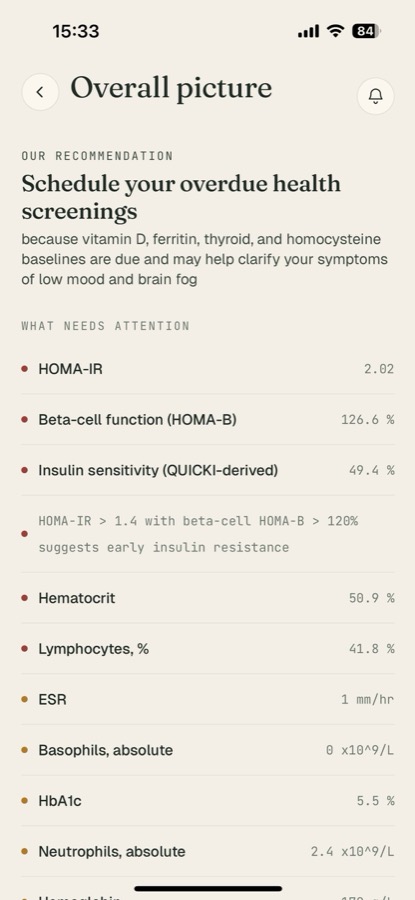
On this Bevita “Overall picture” screen, HbA1c reads a normal 5.5% — but the app calculates what the raw values hide: HOMA-IR 2.02 and beta-cell function 126.6%, flagged as “early insulin resistance.” That’s the fat-storage signal running high while blood sugar still looks fine — exactly the metabolic state that makes weight climb and stick.
Instead of a normal glucose reading that says “nothing to see here,” Bevita surfaces the insulin picture behind it, and tracks it over time so you can see whether interventions are actually moving it.
What to do
- Ask for the metabolic panel above — specifically name fasting insulin and thyroid, since these get skipped.
- Rule out thyroid first — it’s a simple test and a common, very treatable cause.
- Check insulin, not just glucose — the earliest and most common driver hides there.
- Track the trend — metabolic change is gradual; a series of tests shows whether you’re improving.
- Talk to a clinician to build the right plan around what the numbers show.
References
- Centers for Disease Control and Prevention. National Diabetes Statistics Report.
- Freeman AM, Acevedo LA, Pennings N. Insulin Resistance. StatPearls, NCBI.
- Ettleson MD, et al. Trends in Prevalence of Thyroid Dysfunction, J Clin Endocrinol Metab.
- National Institute of Diabetes and Digestive and Kidney Diseases (NIDDK). Hypothyroidism (Underactive Thyroid).
This article is for education and isn’t medical advice. Discuss your results with a qualified clinician.
Track your metabolic markers with Bevita
If your weight has climbed without a clear reason, the answer is usually in the relationship between your thyroid, insulin, and blood-sugar markers — read together, over time. Upload your labs to Bevita and it calculates HOMA-IR, flags what’s drifting, and ties it to the symptoms you log. Download Bevita, upload your bloodwork, and find the metabolic driver behind the scale.