Most thyroid results follow a predictable logic: if your TSH is high, your T4 is usually low, because the pituitary is shouting at an underactive thyroid. So when a report shows both TSH and T4 elevated, it stops people — it doesn’t fit the usual story. That instinct is right: it’s an unusual pattern, and it means something specific.
First, the normal logic
TSH is the pituitary’s signal to the thyroid. In the common scenario (primary hypothyroidism):
- Thyroid underactive → T4 drops → pituitary compensates → TSH rises. High TSH, low T4.
So the textbook pairing is high TSH with low (or low-normal) T4. When T4 is also high, that feedback loop is behaving abnormally — and that’s the clue. (For the difference between total and free thyroid hormones, see Free T3 and Free T4.)
What “both high” actually points to
When TSH and free T4 are genuinely both elevated, the main possibilities are (NCBI case literature; European Thyroid Association guidelines):
- TSH-secreting pituitary adenoma (TSHoma) — a rare pituitary tumor that keeps producing TSH despite high thyroid hormone, overriding the normal feedback.
- Resistance to thyroid hormone (RTH) — a usually genetic condition where tissues respond poorly to thyroid hormone, so hormone and TSH both run high.
- Lab artifacts / interference — biotin supplements, certain antibodies, or assay quirks can falsely produce the pattern.
- Medication timing — recent changes to, or irregular use of, levothyroxine can transiently distort the pairing.
These are specialist territory — but the everyday takeaway is simple: an unusual pairing gets confirmed and investigated, not guessed at.
Why you shouldn’t panic — but shouldn’t ignore it
Because lab interference and timing are common explanations, a single “both high” result is often repeated before anything is concluded. But if it’s real, the causes (like a TSHoma) genuinely need treatment, so it’s not something to shrug off either. The correct path is repeat testing with additional markers and an endocrinology referral.
What this looks like in Bevita
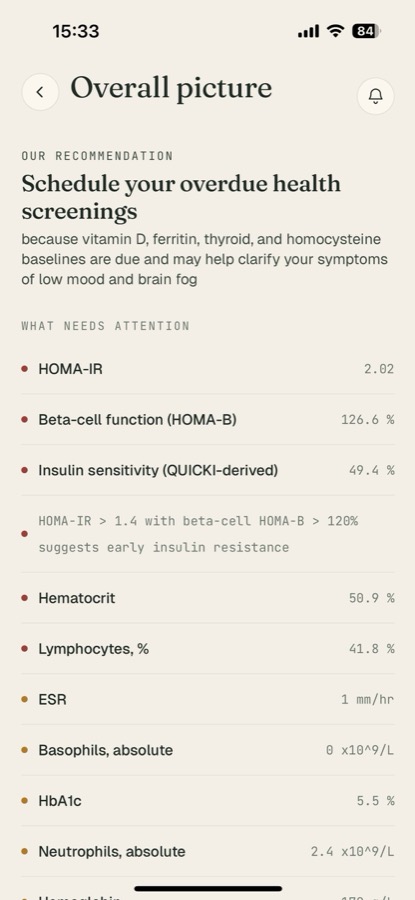
An unusual pattern like this is exactly where seeing your thyroid markers together and over time helps. Bevita tracks TSH, free T4, free T3, and antibodies side by side, so a genuinely discordant result stands out from a one-off lab blip — and you can see whether a repeat test confirms it. That’s the context a single PDF, read in isolation, can’t give you before an appointment.
What to do
- Don’t self-diagnose from one result — the pattern is unusual and often needs confirmation.
- Ask about a repeat test with free T4, free T3, and possibly additional markers.
- Mention biotin/supplements — they’re a common cause of assay interference.
- Get an endocrinology referral — central causes need specialist evaluation.
References
- Central Hyperthyroidism due to TSH-Secreting Pituitary Adenoma. NCBI / PMC.
- European Thyroid Association. Guidelines for the Diagnosis and Treatment of Thyrotropin-Secreting Pituitary Tumors.
- National Institute of Diabetes and Digestive and Kidney Diseases (NIDDK). Hypothyroidism (Underactive Thyroid).
This article is for education and isn’t medical advice. Discuss your results with a qualified clinician.
Track your thyroid panel with Bevita
An unusual thyroid pattern makes the most sense when every marker is read together and confirmed over time. Upload your labs to Bevita and it tracks TSH, free T4, free T3, and antibodies as one picture, so discordant results stand out and repeat tests are easy to compare. Download Bevita, upload your thyroid results, and bring a clear picture to your specialist.