If you’ve had your thyroid checked, it was almost certainly a TSH test. It’s the standard screen, and for good reason. But TSH has a blind spot: it measures your brain’s signal to the thyroid, not what the thyroid is actually producing. When symptoms don’t match the TSH, that’s where free T4 and free T3 earn their place.
The quick hierarchy
Think of it as a chain of command:
- TSH — the pituitary’s instruction: “make more” (high TSH) or “ease off” (low TSH). An indirect read. (Full guide to high TSH.)
- Free T4 (thyroxine) — the main hormone the thyroid releases. Mostly a reservoir; it gets converted into the active form.
- Free T3 (triiodothyronine) — the active hormone your cells actually use. This is what does the work: energy, temperature, metabolism. When it’s low, the result can look like persistent fatigue or brain fog.
“Free” means the unbound, available fraction — the part that’s actually usable, as opposed to hormone bound to carrier proteins.
The stat most people don’t know
Thyroid dysfunction is common and frequently missed — undiagnosed hypothyroidism affects several percent of adults, and the large majority of it is subclinical, meaning TSH is only mildly off while symptoms are vague (Ettleson et al., J Clin Endocrinol Metab). In those gray-zone cases, looking only at TSH can leave you told you’re “normal” while still feeling unwell.
What the numbers mean
Reference ranges vary by lab and assay — always read your value against your own report’s range — but as a rough guide:
- Free T4: commonly ~0.8–1.8 ng/dL
- Free T3: commonly ~2.3–4.2 pg/mL
How they combine tells the story (American Thyroid Association; NIDDK):
- High TSH + low free T4 → overt hypothyroidism (underactive)
- High TSH + normal free T4 → subclinical hypothyroidism
- Low TSH + high free T4/T3 → hyperthyroidism (overactive)
- Normal TSH + symptoms → where free T4/T3 (and antibodies) add the most value
When free T3/T4 matter most
For routine screening, TSH usually does the job. Free hormones earn their keep when:
- Your symptoms don’t match a normal or borderline TSH
- You’re monitoring known thyroid disease or treatment
- Your clinician needs to distinguish the type of dysfunction
What this looks like in Bevita
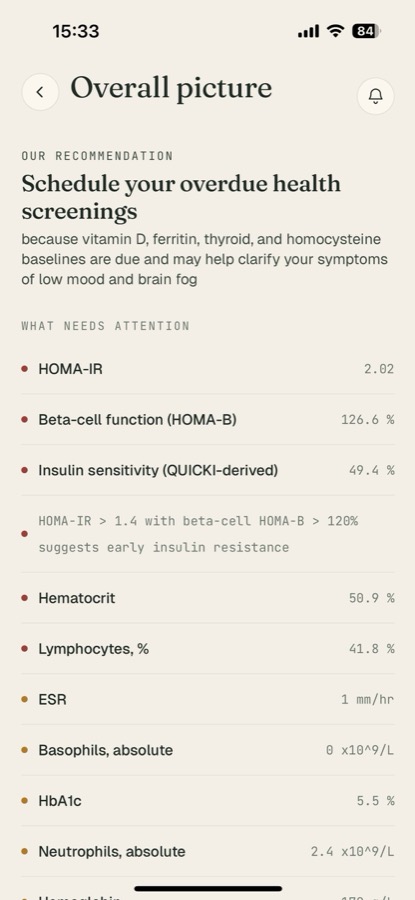
On this Bevita “Overall picture” screen, thyroid is flagged among the baselines that are due — tied to logged symptoms of low mood and brain fog. Bevita tracks TSH, free T4, free T3, and thyroid antibodies together, against your own lab’s ranges, and over time — so a TSH creeping up while free T4 drifts down becomes a visible trend instead of two “still normal” snapshots read months apart.
What to do
- Start with TSH — it’s the right first screen for most people.
- Add free T4 (± free T3) if symptoms don’t fit the TSH, or to monitor known thyroid disease.
- Read against your own lab’s range, and watch the trend, not one value.
- Talk to a clinician — thyroid interpretation depends on the full pattern, including antibodies.
References
- American Thyroid Association. Thyroid Function Tests.
- National Institute of Diabetes and Digestive and Kidney Diseases (NIDDK). Hypothyroidism (Underactive Thyroid).
- Ettleson MD, et al. Trends in Prevalence of Thyroid Dysfunction. Journal of Clinical Endocrinology & Metabolism.
This article is for education and isn’t medical advice. Discuss your results with a qualified clinician.
Track your thyroid with Bevita
Your thyroid only makes sense as a full picture — TSH, free T4, free T3, and antibodies, read together and tracked over time. Upload your labs to Bevita and it tracks every thyroid marker against your lab’s ranges, flags what’s drifting, and ties it to your symptoms. Download Bevita, upload your thyroid panel, and see the whole picture, not just the signal.