A high TSH means your pituitary is working overtime to prod an underactive thyroid. Since thyroid hormone sets your body’s metabolic pace, an underactive thyroid tends to slow everything down — energy, temperature, digestion, mood. But the symptoms are famously vague, which is exactly why they’re so often blamed on stress, aging, or “just being busy.”
The classic symptoms
An elevated TSH (underactive thyroid) commonly produces (NIDDK; American Thyroid Association):
- Fatigue that doesn’t improve with sleep
- Unexplained weight gain or difficulty losing weight (the blood markers behind weight gain)
- Cold intolerance — feeling cold when others are comfortable (cold hands and feet)
- Dry skin and thinning hair (hair loss and blood work)
- Constipation
- Brain fog and difficulty concentrating (brain fog markers)
- Low mood or depression
- Heavier or irregular periods
- Muscle aches and slowed heart rate
Because these overlap with so many other things (including low iron and low vitamin D), the thyroid connection is easy to miss until someone looks at the TSH.
The stat most people don’t know
Here’s the twist: you can have a high TSH and feel completely fine. In subclinical hypothyroidism — a mildly elevated TSH (roughly 4–10) with still-normal thyroid hormone — many people have few or no symptoms, and undiagnosed hypothyroidism (mostly this milder form) affects several percent of adults (Ettleson et al., J Clin Endocrinol Metab). That’s why treatment decisions weigh symptoms and the number and the trend — not the TSH alone.
Why symptoms and the number don’t always match
There’s no clean threshold where symptoms switch on. It depends on how sensitive you are, how quickly TSH rose, and your free T4 level. Someone can feel rough at a TSH of 6; another feels fine at 9. This mismatch is the whole reason a high TSH is best interpreted in context — beside free T4, antibodies, and how you actually feel, tracked over time. (For the reasons TSH rises in the first place, see what causes high TSH.)
What this looks like in Bevita
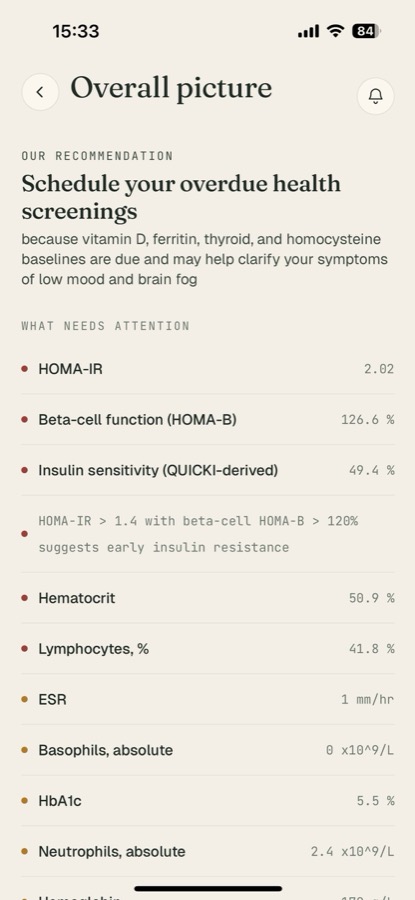
Because thyroid symptoms are so non-specific, the useful move is connecting them to the numbers. On this Bevita “Overall picture” screen, thyroid is flagged and tied directly to logged symptoms of low mood and brain fog. Bevita lets you log how you feel and reads it against your TSH and free T4 over time — so “I’ve been exhausted and cold for months” lines up with a rising TSH instead of getting dismissed.
What to do
- Note your symptoms — and get your actual TSH and free T4 numbers, not just “normal.”
- Check for the cause — ask about TPO antibodies (Hashimoto’s is the usual reason).
- Track symptoms against the trend — a rising TSH with worsening symptoms is more actionable than one reading.
- Talk to a clinician — especially if TSH is above 10 or symptoms are significant.
References
- National Institute of Diabetes and Digestive and Kidney Diseases (NIDDK). Hypothyroidism (Underactive Thyroid).
- American Thyroid Association. Hypothyroidism.
- Ettleson MD, et al. Trends in Prevalence of Thyroid Dysfunction. Journal of Clinical Endocrinology & Metabolism.
This article is for education and isn’t medical advice. Discuss your results with a qualified clinician.
Track your thyroid symptoms with Bevita
Thyroid symptoms only make sense next to your numbers, over time. Upload your labs to Bevita, log how you feel, and it ties your symptoms to your TSH and free T4 trend — so a slow slide into an underactive thyroid gets caught, not dismissed. Download Bevita, upload your thyroid results, and connect how you feel to what your labs say.