A high TSH is one of the most common abnormal results on a routine blood panel. It almost always points the same direction — an underactive thyroid — because TSH is the pituitary’s way of shouting louder when the thyroid isn’t producing enough hormone. But why the thyroid is underperforming can differ, and the cause shapes what happens next.
The stat most people don’t know
The overwhelming majority of high-TSH cases trace to one thing: Hashimoto’s thyroiditis is the most common cause of hypothyroidism in developed countries, and about 90% of people with it have positive TPO antibodies (StatPearls / NCBI; American Thyroid Association). Yet the antibody test that identifies it is often never ordered — so people learn their TSH is high without learning the reason.
The common causes of a high TSH
- Hashimoto’s thyroiditis (autoimmune) — the leading cause; the immune system slowly reduces thyroid output. (TPO antibodies explained.)
- Subclinical hypothyroidism — a mildly high TSH (roughly 4–10) with still-normal T4; an early stage. (Free T3/T4 context.)
- Under-treatment in known hypothyroidism — the most common “cause” in people already on levothyroxine: dose too low, missed doses, or absorption issues (taken with food, coffee, iron, or calcium).
- Iodine imbalance — both too little and too much iodine can push TSH up.
- Medications — lithium and amiodarone are classic examples.
- Recovery from illness — TSH can rebound upward after a non-thyroidal illness.
- Thyroid surgery or radiation history — reduced thyroid tissue means a higher TSH to compensate.
Why the trend matters more than one reading
A mildly elevated TSH is often transient — from timing, a recent illness, or day-to-day variation. That’s why a borderline result is usually re-checked in a few weeks to months rather than treated immediately. A TSH that’s climbing across several tests tells a very different story than one that bounced up once and settled. (For unusual patterns where T4 is also high, see high TSH with high T4.)
What this looks like in Bevita
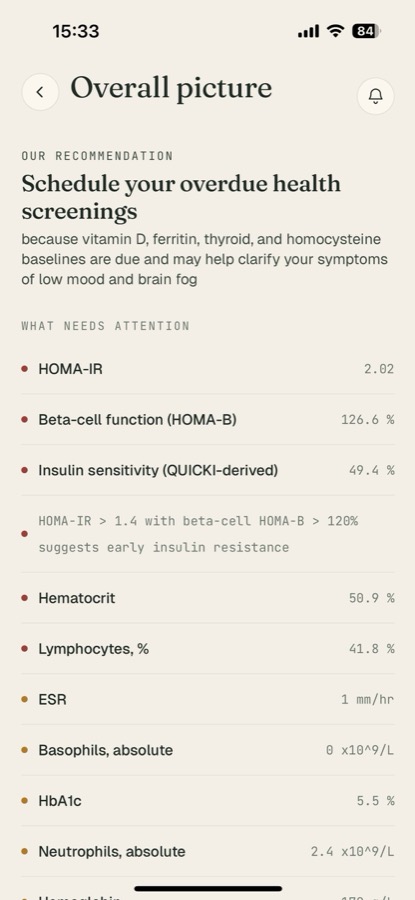
Finding the cause of a high TSH means looking beyond the single number — at antibodies, at free T4, and at the trend. Bevita tracks TSH alongside TPO antibodies and free T4 over time, so a high TSH with positive antibodies reads as likely Hashimoto’s, while a one-off bump that settles reads as transient. That context is what turns “your TSH is high” into an actual explanation.
What to do
- Ask for TPO antibodies and free T4 alongside TSH — they point to the cause, not just the number.
- Review your medications and supplements — including how you take levothyroxine if you’re on it.
- Re-test a mildly high TSH in a few weeks to months to see if it’s real or transient.
- Talk to a clinician to match the cause to the right next step.
References
- Mincer DL, Jialal I. Hashimoto Thyroiditis. StatPearls, NCBI.
- American Thyroid Association. Hashimoto’s Thyroiditis.
- National Institute of Diabetes and Digestive and Kidney Diseases (NIDDK). Hypothyroidism (Underactive Thyroid).
This article is for education and isn’t medical advice. Discuss your results with a qualified clinician.
Track your TSH with Bevita
The cause of a high TSH lives in the markers around it and the trend over time. Upload your labs to Bevita and it tracks TSH with your antibodies and free T4, flags the likely pattern, and shows whether it’s climbing or settling. Download Bevita, upload your thyroid results, and find the reason behind the number.