If your thyroid is underactive, there’s a good chance you’ve never been told why. The most common cause — by a wide margin — is an autoimmune condition called Hashimoto’s, and the test that reveals it isn’t TSH. It’s thyroid antibodies, and they’re often left off the standard panel.
What TPO antibodies are
Your immune system normally leaves your own tissues alone. In autoimmune thyroid disease, it doesn’t — it produces antibodies against thyroid peroxidase (TPO), an enzyme your thyroid needs to make hormones. Measuring TPO antibodies tells you whether an autoimmune process is attacking your thyroid, which a TSH test alone can’t show.
The stat most people don’t know
Hashimoto’s thyroiditis is the most common cause of hypothyroidism in developed countries, and about 90% of people with Hashimoto’s have positive TPO antibodies (Mincer & Jialal, StatPearls / NCBI; American Thyroid Association). It’s also one of the most common autoimmune conditions overall. Yet TPO antibodies are frequently not tested — so people get told their TSH is “a bit high” without ever learning the underlying reason.
Why it matters even with a “normal” TSH
Here’s the key insight: TPO antibodies can be elevated years before your TSH clearly rises. The autoimmune attack builds first; the thyroid compensates for a while; only later does TSH drift up. (This is the same “the signal lags the cause” pattern seen with high TSH and insulin resistance.) So positive antibodies with a normal TSH isn’t nothing — it identifies who’s most likely to become hypothyroid, and who should be monitored.
When to ask for TPO antibodies
- Thyroid symptoms (fatigue, weight gain, cold intolerance, hair loss, brain fog) with a borderline or normal TSH
- A family history of thyroid or autoimmune disease
- A known high or rising TSH, to identify the cause
- Planning pregnancy — thyroid autoimmunity can affect it
What this looks like in Bevita
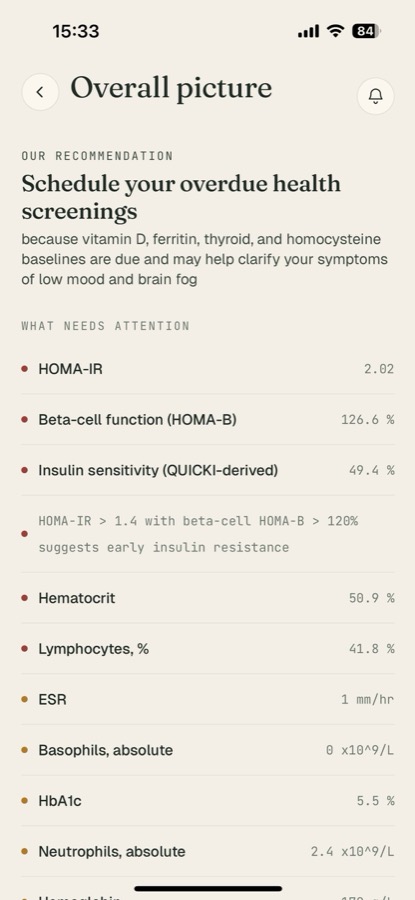
Bevita tracks thyroid antibodies alongside TSH, free T4, and free T3 — not as isolated values but as a picture over time. On this “Overall picture” screen, thyroid is flagged among the baselines due, tied to logged symptoms. If your TPO antibodies are positive while TSH still looks normal, Bevita keeps that on your radar and tracks whether TSH is starting to drift — so the autoimmune process is caught early instead of years later.
What to do
- Ask for TPO antibodies (and often thyroglobulin antibodies) if you have thyroid symptoms or a family history — they’re not always in a standard panel.
- Don’t panic over a positive result — it flags risk and the need for monitoring, not automatic treatment.
- Monitor over time — track TSH and free T4 periodically if antibodies are positive.
- Talk to a clinician — especially before pregnancy, or if symptoms are significant.
References
- Mincer DL, Jialal I. Hashimoto Thyroiditis. StatPearls, NCBI.
- American Thyroid Association. Hashimoto’s Thyroiditis.
- National Institute of Diabetes and Digestive and Kidney Diseases (NIDDK). Hypothyroidism (Underactive Thyroid).
This article is for education and isn’t medical advice. Discuss your results with a qualified clinician.
Track your thyroid with Bevita
Thyroid antibodies only mean something in context — read alongside TSH and free T4, and tracked over time. Upload your labs to Bevita and it tracks TPO antibodies with your full thyroid panel, flags what’s drifting, and ties it to your symptoms. Download Bevita, upload your thyroid results, and find out what’s really going on.