Some people just run cold — and often it’s nothing. But persistently cold hands and feet, especially when they come with other symptoms, can be a small clue pointing at something testable in your blood. The three usual suspects are iron, thyroid, and circulation, and it’s worth knowing how to tell them apart.
The stat most people don’t know
Iron deficiency is the most common nutritional deficiency in the world, affecting up to a quarter of the global population (WHO) — and impaired temperature regulation is one of its lesser-known effects, because iron is needed both to carry oxygen and to generate body heat. Add an underactive thyroid, which is also common and also lowers body temperature, and a large share of “I’m always cold” has a findable cause.
The three usual suspects
1. Low iron
Iron carries oxygen and supports heat production, so low stores leave your extremities cold — often with fatigue and breathlessness on exertion. Ferritin catches it earliest, before full anemia; a level below ~30 ng/mL is highly specific for iron deficiency (AAFP). (See what low ferritin means.)
2. Underactive thyroid
Thyroid hormones set your metabolic rate and heat output, so an underactive thyroid makes you feel cold when others are comfortable — usually alongside fatigue, weight gain, and dry skin. TSH (± free T4) is the screen. (See high TSH explained.)
3. Circulation (including Raynaud’s)
Sometimes the issue is blood flow, not blood chemistry. Raynaud’s phenomenon causes fingers and toes to go white or blue and cold in response to cold or stress. It’s often benign but worth mentioning to a clinician, especially if color changes are dramatic.
How to tell them apart
The company the coldness keeps is the clue:
- Cold + fatigue + breathlessness on exertion → think iron (and the wider fatigue panel)
- Cold + weight gain + dry skin + constipation → think thyroid
- Cold + color changes in fingers/toes with cold or stress → think circulation/Raynaud’s
Often it’s a combination, which is exactly why testing beats guessing.
What this looks like in Bevita
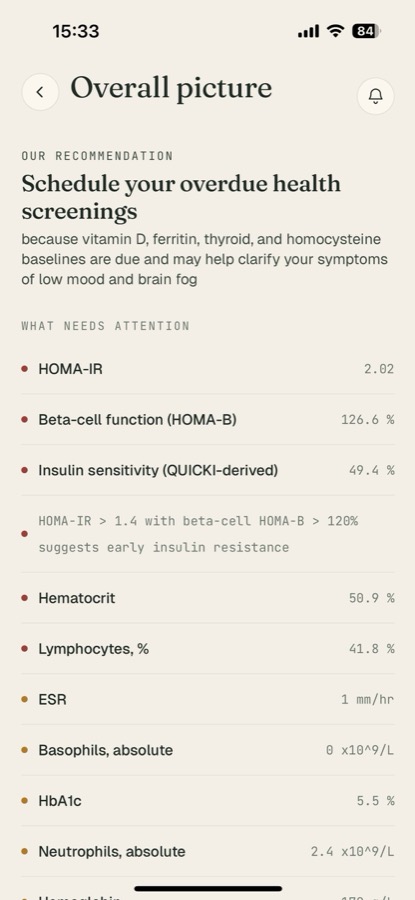
On this Bevita “Overall picture” screen, the recommendation flags ferritin and thyroid baselines as due — the two blood-chemistry causes of feeling cold — and ties them to logged symptoms. Rather than wondering whether a ferritin of 28 or a TSH of 4.1 explains why you’re always cold, Bevita flags them against functional targets, tracks them over time, and connects the trend to what you’re feeling.
What to do
- Check ferritin and TSH first — they cover the two most common testable causes.
- Note the accompanying symptoms — they point toward iron vs thyroid vs circulation.
- Mention color changes (white/blue fingers) to your clinician — that’s the circulation angle.
- Track over time and talk to a clinician to interpret the results together.
References
- World Health Organization. Anaemia.
- Short MW, Domagalski JE. Iron Deficiency Anemia: Evaluation and Management. AAFP.
- National Institute of Diabetes and Digestive and Kidney Diseases (NIDDK). Hypothyroidism (Underactive Thyroid).
This article is for education and isn’t medical advice. Discuss your results with a qualified clinician.
Track the markers behind cold hands with Bevita
Feeling cold makes more sense once you can see your iron and thyroid markers together and over time. Upload your labs to Bevita and it flags ferritin and thyroid against functional targets, ties them to your symptoms, and shows the trend at your next test. Download Bevita, upload your bloodwork, and find out what’s behind the chill.