Losing more hair than usual is alarming, and the default assumption is often genetics or age. But a large share of sudden or diffuse shedding — the kind where hair thins all over rather than in a pattern — has a testable cause sitting in routine blood work. Before resigning yourself to it, it’s worth checking the markers that most commonly drive it.
The stat most people don’t know
In studies of women with telogen effluvium — the medical term for diffuse hair shedding — average ferritin levels were markedly lower than in women without shedding (one study found means of about 24 ng/mL in cases versus 45 ng/mL in controls), and low serum ferritin is significantly associated with the condition (Assessment of Serum Ferritin in Telogen Effluvium, NCBI). The catch: much of that low ferritin sits inside the lab’s “normal” range, so it’s rarely flagged as the cause.
The markers worth checking
- Ferritin (iron stores) — the big one for hair. While anemia is defined lower, the hair-regrowth target many dermatologists use is ≥40–50 ng/mL, well above the lab’s floor. (What low ferritin means; AAFP.)
- Thyroid (TSH ± free T4) — both under- and overactive thyroid cause diffuse thinning, usually reversible once corrected. (High TSH, explained; NIDDK.)
- Vitamin D — deficiency is linked to hair-cycle disruption and several forms of hair loss (NIH ODS).
- Vitamin B12 and zinc — deficiencies can contribute, especially in vegetarians, vegans, and after rapid weight loss.
Often it’s not one marker but a combination — low-ish ferritin plus a borderline thyroid, for example — that tips hair into shedding.
Why timing confuses people
Telogen effluvium has a frustrating quirk: the shedding usually shows up 2–4 months after the trigger (an illness, crash diet, stress, childbirth, or a nutrient dip). So by the time your hair is visibly thinning, the blood-work cause may have been building for months — which is exactly why a single “how are things now” test can miss it, and why tracking your markers over time matters.
What this looks like in Bevita
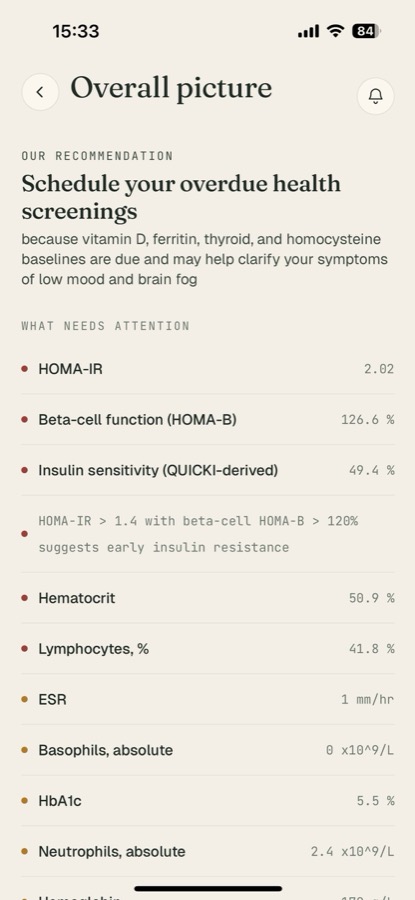
On this Bevita “Overall picture” screen, the recommendation flags exactly the hair-relevant markers — vitamin D, ferritin, and thyroid baselines are due — and ties them to logged symptoms. Rather than eyeballing whether a ferritin of 28 is “fine,” Bevita flags it against the functional target, tracks it across tests, and connects a downward trend to the shedding you’re seeing — so you can tell whether iron or thyroid is the likely driver instead of guessing.
What to do
- Ask for ferritin, thyroid (TSH), vitamin D, B12, and zinc — name ferritin specifically, since the “normal” floor hides hair-relevant lows.
- Get your real numbers and compare against functional targets (ferritin ≥40–50 for hair), not just the lab range.
- Be patient and track — shedding lags its cause by months, and regrowth after correcting a deficiency also takes months. Re-test at ~3 months.
- See a clinician or dermatologist — especially if shedding is heavy, patterned, or persistent.
Track the markers behind your hair with Bevita
Hair shedding makes a lot more sense once you can see your ferritin, thyroid, and vitamin D together and over time. Upload your labs to Bevita and it flags the hair-relevant markers against functional targets, ties them to your symptoms, and shows the trend at your next test. Download Bevita, upload your bloodwork, and find out what’s actually behind the shedding.
References
- Assessment of Serum Ferritin Levels in Female Patients With Telogen Effluvium. NCBI / PMC.
- Short MW, Domagalski JE. Iron Deficiency Anemia: Evaluation and Management. AAFP.
- National Institute of Diabetes and Digestive and Kidney Diseases (NIDDK). Hypothyroidism (Underactive Thyroid).
- National Institutes of Health, Office of Dietary Supplements. Vitamin D — Health Professional Fact Sheet.
This article is for education and isn’t medical advice. Discuss your results with a qualified clinician.