If you could only track one blood sugar number, HbA1c would be it. Unlike a fasting glucose test — a single reading that swings with what you ate, how you slept, and how stressed you were that morning — HbA1c gives you the average of the last three months in a single percentage. It’s steadier, it doesn’t need fasting, and it’s the marker doctors use to screen for and diagnose diabetes.
But it’s also widely misunderstood. A “normal” HbA1c can still be quietly trending in the wrong direction, and the number can be thrown off entirely by things that have nothing to do with your diet.
What HbA1c actually measures
Sugar in your blood sticks to hemoglobin, the protein in red blood cells. The more sugar circulating over time, the more of your hemoglobin ends up “sugar-coated.” HbA1c is simply the percentage of your hemoglobin that has sugar attached.
Because red blood cells live about three months, that percentage reflects your average blood sugar over roughly that window — not just today. That’s what makes it powerful: it smooths out the daily noise.
The stat most people don’t know
The CDC estimates that about 96 million American adults — more than 1 in 3 — have prediabetes, and over 80% don’t know it (CDC). HbA1c is one of the cheapest, easiest ways to catch it, yet it’s often only checked once symptoms appear. By then, blood sugar has usually been drifting upward for years.
What the numbers mean
- Below 5.7% — normal
- 5.7% – 6.4% — prediabetes
- 6.5% or higher (confirmed on two tests) — diabetes
(Diagnostic thresholds per the American Diabetes Association and CDC.)
And the nuance that matters: many clinicians focused on metabolic health treat 4.8–5.4% as the optimal zone. An HbA1c of 5.6% is technically “normal,” but if it’s climbed from 5.1% to 5.4% to 5.6% over three years, the direction is the real story — not the fact that it hasn’t crossed a line yet. (This is the same blind spot behind early insulin resistance, where insulin rises long before glucose does.)
When HbA1c can mislead you
Because it depends on red blood cells, anything that changes how long they live can skew the result:
- Iron deficiency anemia can push HbA1c falsely high.
- Recent blood loss, blood donation, or pregnancy can push it falsely low.
- Certain hemoglobin variants interfere with the measurement entirely.
If your HbA1c doesn’t line up with your glucose readings, one of these is usually why — which is exactly why it helps to see it next to your other markers, not in isolation.
What this looks like in Bevita
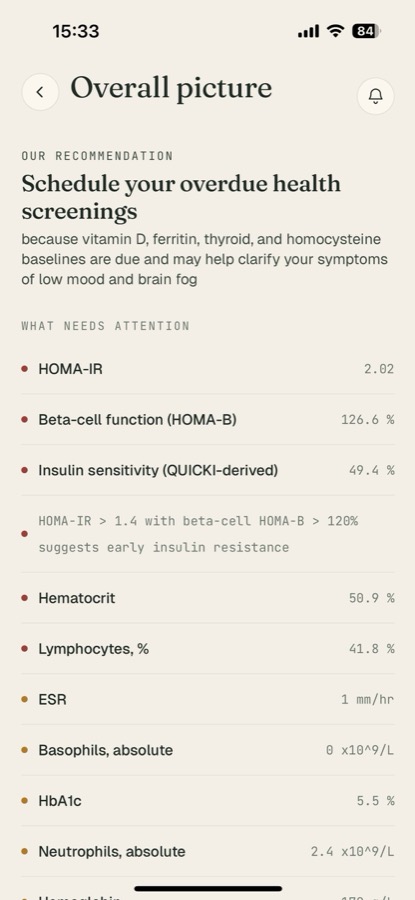
On this Bevita “Overall picture” screen, HbA1c reads 5.5% — squarely in the “normal” band. On a standard lab report that’s where the story would end. But Bevita places it next to HOMA-IR (2.02) and beta-cell function (126.6%), which together suggest early insulin resistance. So the same person with a “normal” HbA1c is actually showing the earliest metabolic strain — the kind that would push that 5.5% higher over the next few years if nothing changes.
That’s the value of reading markers together and over time: HbA1c alone said “fine,” but in context it’s an early warning worth acting on now, while it’s still easy to reverse.
What to do
- Get an HbA1c if you haven’t in the last year — especially with a family history of diabetes or extra weight around the middle. (New to lab reports? Start with how to read blood test results.)
- Ask for fasting insulin too — it catches metabolic trouble even earlier than HbA1c does.
- Watch the trend, not just the line. A number climbing within “normal” is still climbing.
- Re-test after changes at ~3 months — that’s the window HbA1c needs to reflect a real shift.
- Talk to a clinician to interpret it alongside your other markers.
If you’d rather not keep your results in a folder of PDFs, we compared the apps that track HbA1c and blood sugar over time.
References
- Centers for Disease Control and Prevention. National Diabetes Statistics Report.
- American Diabetes Association. Understanding A1C.
- Centers for Disease Control and Prevention. Diabetes Testing.
This article is for education and isn’t medical advice. Discuss your results with a qualified clinician.
Track your HbA1c with Bevita
A single HbA1c tells you where you are; a series tells you where you’re headed — and where you’re headed is what you can actually change. Upload your labs to Bevita and it tracks your HbA1c across every test, flags when it’s drifting even within the normal range, and shows it beside your insulin and iron markers so the number means something. Download Bevita, upload your results, and see what your blood sugar has really been doing.