A prediabetes result can feel like a countdown to diabetes. It isn’t. Prediabetes is one of the most reversible conditions in medicine — and the evidence for that isn’t a wellness slogan, it’s one of the most cited trials in preventive health.
The stat most people don’t know
In the landmark Diabetes Prevention Program (DPP), lifestyle changes — modest weight loss plus regular activity — reduced progression from prediabetes to type 2 diabetes by 58%, and by 71% in adults over 60 (American Diabetes Association; Diabetes Care / ADA journal). That beat the medication arm of the same study. And it matters at scale: about 96 million US adults have prediabetes and over 80% don’t know it (CDC) — most are sitting on a reversible condition unaware.
What actually works
The DPP wasn’t extreme. It targeted two concrete goals:
- ~7% body-weight loss — for a 180 lb person, about 12–13 lb.
- ≥150 minutes/week of moderate activity — brisk walking counts.
Around those, the changes with the strongest evidence for lowering insulin resistance:
- Cut refined carbs and added sugar — they drive the glucose-insulin swings.
- Build muscle — muscle is a sink for blood sugar; resistance training improves insulin sensitivity.
- Protect sleep — poor sleep worsens insulin resistance directly.
- Move after meals — even a 10-minute walk blunts the post-meal glucose spike (and the afternoon crash).
Why catching it early matters
Prediabetes is the tail end of a process that’s been building for years — insulin rising to compensate while glucose still looks normal. The earlier you intervene, the more reversible it is, because beta-cell function is still largely intact. That’s the whole case for testing fasting insulin and HOMA-IR rather than waiting for HbA1c to cross a line.
The markers to track
- HbA1c — your 3-month average; the headline number for progress.
- Fasting glucose + insulin (HOMA-IR) — catches change earlier than HbA1c.
- Triglycerides and HDL — the triglyceride-to-HDL ratio tends to improve as insulin resistance does.
What this looks like in Bevita
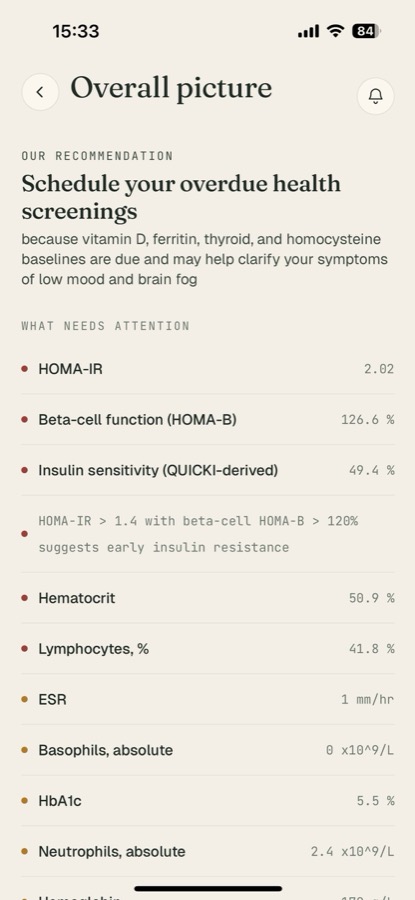
Reversal only feels real when you can see it. On this Bevita “Overall picture” screen, HOMA-IR (2.02) and HbA1c (5.5%) are flagged for early insulin resistance. Track those across tests, and a downward trend after three months of changes becomes visible proof your effort is working — instead of guessing between doctor visits. Bevita calculates HOMA-IR for you and shows the direction, which is exactly the feedback loop that keeps lifestyle changes going.
What to do
- Confirm where you stand — HbA1c plus fasting insulin/glucose for a HOMA-IR.
- Set the DPP targets — ~7% weight loss, 150 min/week activity.
- Re-test at ~3 months — HbA1c needs that long to reflect real change.
- Work with a clinician — especially before major diet changes or if you’re on medication.
References
- American Diabetes Association. National Diabetes Prevention Program (DPP).
- Knowler WC, et al. / NIDDK. The Diabetes Prevention Program and Its Outcomes Study. Diabetes Care.
- Centers for Disease Control and Prevention. National Diabetes Statistics Report.
This article is for education and isn’t medical advice. Discuss your results with a qualified clinician.
Track your progress with Bevita
Reversing prediabetes is a trend you want to watch happen. Upload your labs to Bevita and it tracks your HbA1c and HOMA-IR across every test, flags the direction, and ties it to the changes you’re making. Download Bevita, upload your bloodwork, and watch the numbers move the right way.