If you’re reaching for something sweet every afternoon and blaming your lack of willpower, it’s worth reconsidering. Frequent, intense sugar cravings are less about character and more about biology — specifically, what your blood sugar and insulin are doing across the day. And that biology is testable.
The blood-sugar roller coaster
Here’s the cycle behind most cravings: you eat something high in refined carbs, blood sugar spikes, and your body releases a burst of insulin to bring it back down. If that insulin response is exaggerated — as it often is in early insulin resistance — glucose overshoots downward into a relative low. Your brain reads that dip as an emergency and demands fast energy: more sugar. You eat it, and the cycle repeats.
That’s why cravings so often come with the classic afternoon energy crash — they’re two symptoms of the same swing.
The stat most people don’t know
About 96 million US adults — more than 1 in 3 — have prediabetes, and over 80% don’t know it (CDC) — because standard testing checks glucose, which stays normal for years, rather than fasting insulin, which rises early (StatPearls / NCBI). So the very mechanism driving relentless cravings is often present and undetected, dismissed as a sweet tooth.
The markers to check
- Fasting insulin — the earliest signal that your body is overproducing insulin to manage blood sugar.
- Fasting glucose — pairs with insulin to calculate HOMA-IR, the practical insulin-resistance score.
- HbA1c — your 3-month blood-sugar average; useful, but a lagging indicator that only rises later.
When cravings come with fatigue, midsection weight that won’t budge, or a family history of diabetes, these markers usually tell the story.
What this looks like in Bevita
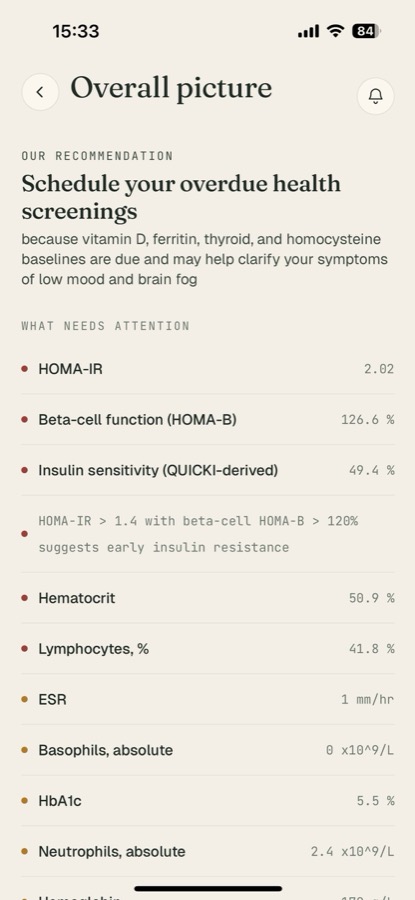
On this Bevita “Overall picture” screen, HbA1c reads a normal 5.5% — the number that would tell you “you’re fine.” But the app calculates the insulin picture underneath: HOMA-IR 2.02 and beta-cell function 126.6%, flagged as early insulin resistance. That’s exactly the state that produces the spike-and-crash cycle behind constant cravings — visible here even though glucose looks normal.
Bevita does the HOMA-IR math and tracks it over time, and if you log symptoms like cravings or afternoon crashes, it ties them to the markers — so “I always want sugar at 3pm” becomes a data point, not a mystery.
What to do
- Check insulin, not just glucose — ask specifically for fasting insulin so HOMA-IR can be calculated.
- Notice the pattern — cravings plus afternoon crashes plus midsection weight point toward the blood-sugar swing.
- Track over time — one reading is a snapshot; a trend shows whether it’s improving.
- Talk to a clinician about diet and lifestyle steps that steady blood sugar — protein, fiber, and meal timing often help.
References
- Centers for Disease Control and Prevention. National Diabetes Statistics Report.
- Freeman AM, Acevedo LA, Pennings N. Insulin Resistance. StatPearls, NCBI.
- National Institute of Diabetes and Digestive and Kidney Diseases (NIDDK). Insulin Resistance & Prediabetes.
This article is for education and isn’t medical advice. Discuss your results with a qualified clinician.
Track the pattern with Bevita
Cravings make a lot more sense once you can see the blood-sugar swing behind them. Upload your labs to Bevita and it calculates your insulin-resistance score, flags it even when glucose looks normal, and ties it to the cravings and crashes you log. Download Bevita, upload your bloodwork, and find out what your sweet tooth is really about.