You’re productive in the morning, and then around 2 or 3pm it hits: focus dissolves, your eyelids get heavy, and suddenly a cookie feels like a medical necessity. The afternoon energy crash is so common it’s treated as normal — but it’s often a readable signal of what your blood sugar is doing across the day.
The blood-sugar roller coaster
The classic crash is a swing. A lunch heavy in refined carbs spikes your glucose; your body releases insulin to bring it back down; and if that insulin response is exaggerated — as it is in early insulin resistance — glucose overshoots downward into a relative low. Your brain reads the dip as an energy emergency and demands fast fuel: fatigue, fog, and a sugar craving, all at once.
The stat most people don’t know
About 96 million US adults — more than 1 in 3 — have prediabetes, and over 80% don’t know it (CDC). One reason it hides: standard screening measures fasting glucose, which stays normal for years, rather than fasting insulin, which rises early (StatPearls / NCBI). So the exact mechanism that exaggerates afternoon crashes is often present and undetected.
What to check
- Fasting insulin + glucose (HOMA-IR) — reveals early insulin resistance behind the swings, before glucose looks abnormal.
- HbA1c — your 3-month blood-sugar average (what it means).
- Ferritin and thyroid — if the tiredness is constant rather than just post-lunch, low iron or an underactive thyroid may be adding to it (see always tired).
It’s not always just blood sugar
Afternoon slumps also ride on sleep debt, dehydration, big high-carb lunches, and caffeine timing (a coffee that wears off mid-afternoon). Those are worth addressing first. But when crashes are frequent, severe, and paired with cravings and midsection weight, the metabolic angle is worth testing rather than guessing.
What this looks like in Bevita
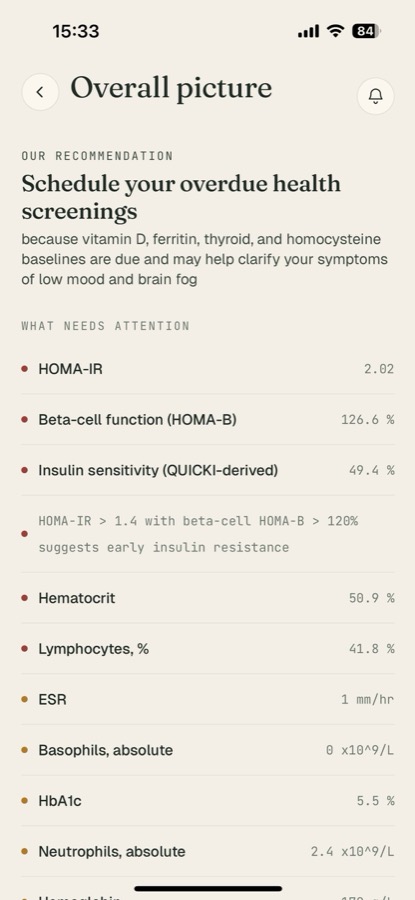
On this Bevita “Overall picture” screen, HbA1c reads a normal 5.5% — the number that says “you’re fine.” But Bevita calculates HOMA-IR (2.02) from fasting insulin and glucose, flagging early insulin resistance the HbA1c misses. That’s the metabolic state that exaggerates the spike-and-crash cycle. If you log an afternoon crash, Bevita ties it to these markers — turning “I always hit a wall at 3pm” into a data point with a likely cause.
What to do
- Notice the pattern — crashes plus cravings plus midsection weight point toward the blood-sugar swing.
- Check insulin, not just glucose — ask for fasting insulin so HOMA-IR can be calculated.
- Fix the easy inputs first — sleep, hydration, a lighter/protein-forward lunch, caffeine timing.
- Track over time and talk to a clinician about steadying blood sugar.
References
- Centers for Disease Control and Prevention. National Diabetes Statistics Report.
- Freeman AM, Acevedo LA, Pennings N. Insulin Resistance. StatPearls, NCBI.
- National Institute of Diabetes and Digestive and Kidney Diseases (NIDDK). Insulin Resistance & Prediabetes.
This article is for education and isn’t medical advice. Discuss your results with a qualified clinician.
Track the pattern with Bevita
The afternoon crash makes sense once you can see the blood-sugar swing behind it. Upload your labs to Bevita and it calculates your insulin-resistance score, flags it even when glucose looks normal, and ties it to the crashes and cravings you log. Download Bevita, upload your bloodwork, and find out what’s behind the 3pm wall.