Most people think of gout as an old-fashioned ailment — a suddenly excruciating big toe. It’s real and painful, but the more useful way to think about gout and its underlying marker, uric acid, is as a window into your metabolic health. High uric acid rarely travels alone.
What uric acid is
Uric acid is a waste product from breaking down purines (found in certain foods and made by the body). When levels get high enough — generally above 6.8 mg/dL, the definition of hyperuricemia — it can crystallize in joints and trigger the inflammation of a gout attack (Role of Diet in Hyperuricemia and Gout, NCBI).
The stat most people don’t know
Here’s the part that reframes gout entirely: over 71% of gout patients aged 40 and older have metabolic syndrome — compared with about 22% of US adults overall (American Journal of Medicine). High uric acid is now considered a marker of insulin resistance, because high insulin makes the kidneys hold onto uric acid. So an elevated uric acid isn’t just about joints — it’s often a flag for the same metabolic picture behind insulin resistance and prediabetes.
What your level means
- Below 6.8 mg/dL — within range for most adults
- Above 6.8 mg/dL — hyperuricemia; raises gout risk and flags metabolic risk
- During an acute attack — uric acid can paradoxically read normal, so timing matters
Not everyone with high uric acid develops gout, and gout is diagnosed clinically (sometimes by analyzing joint fluid) — not by the number alone. But the number still carries metabolic information worth acting on.
The metabolic connection
Because uric acid clusters with high triglycerides, low HDL, high blood pressure, and elevated fasting insulin, it’s effectively part of the metabolic syndrome picture. That means the same levers — reducing sugary drinks and excess alcohol, improving insulin sensitivity, losing excess weight — tend to help uric acid and metabolic health together.
What this looks like in Bevita
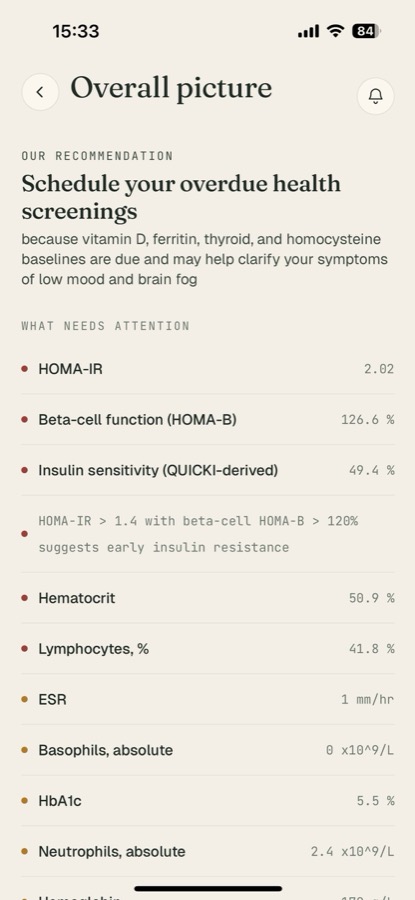
Read in isolation, a uric acid of 7.1 looks like a gout risk and nothing more. Read the way Bevita presents markers on this “Overall picture” screen — next to HOMA-IR, glucose, and lipids — it becomes part of a metabolic pattern. Bevita tracks uric acid over time and flags it alongside the insulin and lipid markers it clusters with, so an elevated level prompts the bigger-picture question instead of just “avoid red meat.”
What to do
- Know your uric acid number — it’s a standard, inexpensive test.
- Read it in metabolic context — high uric acid often signals insulin resistance, so check glucose, insulin, and lipids too.
- Address the shared drivers — alcohol, sugary/fructose intake, excess weight.
- See a clinician for recurrent gout or significantly elevated levels — it may need specific treatment beyond diet.
References
- Vazquez-Mellado J, et al. / American Journal of Medicine. Metabolic Syndrome in Individuals with Hyperuricemia.
- Danve A, et al. The Role of Diet in Hyperuricemia and Gout. NCBI / PMC.
- National Institute of Diabetes and Digestive and Kidney Diseases (NIDDK). Gout.
This article is for education and isn’t medical advice. Discuss your results with a qualified clinician.
Track your uric acid with Bevita
Uric acid means more when it’s read alongside your metabolic markers, over time. Upload your labs to Bevita and it tracks uric acid, flags it next to your insulin and lipid markers, and connects the dots a single number hides. Download Bevita, upload your bloodwork, and see the bigger picture behind gout.