There’s a blood test that can flag metabolic trouble up to a decade before a standard checkup would — and most people have never had it run. It’s not exotic or expensive. It’s fasting insulin, and it’s one of the most useful early-warning markers in all of routine blood work. It just isn’t part of the standard screening most doctors order.
Why insulin, not just glucose
Your body’s first response to rising blood sugar isn’t to let glucose climb — it’s to release more insulin to push that sugar into cells. So in the early stages of insulin resistance, glucose stays perfectly normal because insulin is quietly working overtime to keep it there.
That’s the catch with standard screening. A fasting glucose test and even HbA1c measure the sugar — the thing that stays normal longest. Fasting insulin measures the effort your body is spending to keep it normal. Which means insulin starts rising years before glucose does.
The stat most people don’t know
The CDC estimates about 96 million US adults — more than 1 in 3 — have prediabetes, and over 80% don’t know it (CDC). A big reason for the blind spot: the standard tests measure the lagging signal. By the time fasting glucose or HbA1c crosses into the abnormal range, insulin resistance has often been building for 10 to 15 years (StatPearls / NCBI) — a window in which a fasting insulin test could have caught it while it was still easy to reverse.
What the numbers mean
- Standard “normal”: labs often go up to ~25 µIU/mL — a very wide range.
- Optimal (metabolic-health view): many clinicians target under ~6–8 µIU/mL fasting.
- Worth attention: fasting insulin in the teens with normal glucose — a classic sign your body is compensating.
Combined with fasting glucose, fasting insulin is what lets you calculate HOMA-IR, the practical insulin-resistance score. That’s why the two together tell you far more than glucose alone. (Full guide: how to know if you have insulin resistance.)
If you’ve noticed that every source quotes a different cutoff, there’s a concrete reason for it — insulin assays were never standardized between laboratories. Why fasting insulin ranges disagree covers what that means for reading your own result.
What this looks like in Bevita
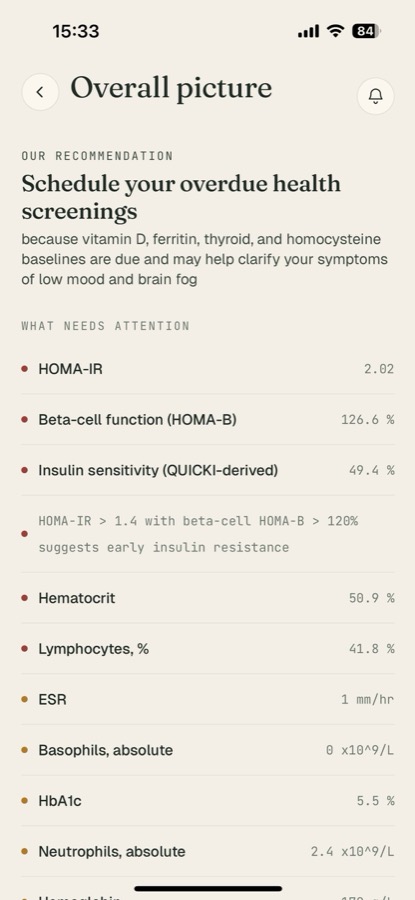
Here’s why fasting insulin matters in practice. On this Bevita screen, glucose and HbA1c (5.5%) both read normal — but because a fasting insulin value is available, the app can calculate what the raw numbers hide: HOMA-IR 2.02, beta-cell function 126.6%, insulin sensitivity 49.4%, with the flag “suggests early insulin resistance.”
Without fasting insulin, none of that is computable — you’d just see a normal glucose and move on. With it, you catch the compensation phase in the act. Bevita does the HOMA-IR math for you and tracks it across every test, so a slow drift upward becomes visible instead of invisible.
What to do
- Ask specifically for fasting insulin alongside fasting glucose — it’s usually not included by default, so you have to request it by name.
- Fast properly (typically 8–12 hours) — insulin is sensitive to recent food, so the draw needs to be genuinely fasting.
- Get HOMA-IR calculated from the pair, and look at the trend, not one reading.
- Talk to a clinician to interpret it in context — especially with family history of diabetes or extra weight around the middle.
References
- Centers for Disease Control and Prevention. National Diabetes Statistics Report.
- Freeman AM, Acevedo LA, Pennings N. Insulin Resistance. StatPearls, NCBI.
- National Institute of Diabetes and Digestive and Kidney Diseases (NIDDK). Insulin Resistance & Prediabetes.
This article is for education and isn’t medical advice. Discuss your results with a qualified clinician.
Track fasting insulin with Bevita
Fasting insulin is only powerful if you actually see it — calculated into HOMA-IR and tracked over time, not buried as a lone value on a PDF. Upload your labs to Bevita and it computes your insulin-resistance score, flags it when it’s drifting even while glucose looks normal, and shows the trend at your next test. Download Bevita, add your fasting insulin and glucose, and see the earliest signal your standard checkup misses.