Fatty liver disease has quietly become one of the most common conditions in the world — and most people who have it have no idea, because it rarely causes symptoms until it’s advanced. The clues usually show up first not as how you feel, but as a couple of mildly elevated numbers on a routine blood panel that are easy to wave off.
The stat most people don’t know
Non-alcoholic fatty liver disease — now often called MASLD — has become the most common chronic liver disease worldwide, with global prevalence estimated around 30% of adults (and rising; recent analyses put it as high as 38%) (Younossi et al., Hepatology; NIDDK). In North America it’s roughly 1 in 3 adults. Despite that, it’s usually silent — found incidentally, if at all.
How it shows up in labs
- ALT and AST (liver enzymes) — the classic first hint is mildly elevated ALT, often higher than AST. But enzymes can be normal even with fatty liver, so a normal result doesn’t rule it out. (How to read liver enzymes.)
- GGT — another liver marker that often rises, and is linked to metabolic risk.
- The metabolic context — fatty liver travels with insulin resistance, high triglycerides, low HDL, and elevated fasting glucose. Often it’s the metabolic pattern, not the liver enzymes alone, that raises suspicion.
Because enzymes can be normal, imaging — an ultrasound or a FibroScan — is what confirms it and stages any scarring.
Why it matters
Most fatty liver is simple fat accumulation, which is manageable. But in a subset it progresses to inflammation and scarring, which is far more serious. Since it’s silent, the window to act quietly closes for people who never had the markers connected. And fatty liver is really a metabolic disease — it’s part of the same cluster as metabolic syndrome and prediabetes, which is why it rarely travels alone.
The good news: it’s often reversible
Early fatty liver responds well to the same changes that improve insulin resistance — around 7–10% weight loss, cutting refined carbs and alcohol, and regular activity can meaningfully reduce liver fat. The key is catching it and then tracking whether the enzymes and metabolic markers are trending down.
What this looks like in Bevita
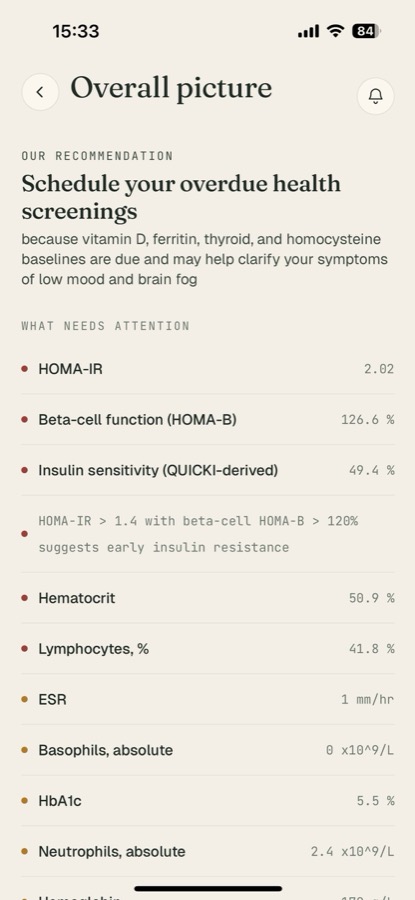
Fatty liver is a connect-the-dots diagnosis, and that’s exactly where a single lab report fails you. Bevita reads your liver enzymes (ALT, AST, GGT) alongside the metabolic markers on this “Overall picture” screen — HOMA-IR, glucose, lipids — so a mildly high ALT sitting next to early insulin resistance reads as a pattern worth acting on, not two “slightly off” numbers ignored separately. It tracks them over time, so you can see liver fat markers improving as you address the metabolic drivers.
What to do
- Look at ALT/AST and GGT on your panel — mildly elevated ALT (esp. > AST) is a common first clue.
- Read them with your metabolic markers — fatty liver rarely travels without insulin resistance or dyslipidemia.
- Ask about imaging (ultrasound / FibroScan) if labs or risk factors suggest it — enzymes alone can miss it.
- Act on the drivers — weight, refined carbs, alcohol, activity — and track with a clinician.
References
- Younossi ZM, et al. The Global Epidemiology of Nonalcoholic Fatty Liver Disease. Hepatology.
- National Institute of Diabetes and Digestive and Kidney Diseases (NIDDK). Nonalcoholic Fatty Liver Disease (NAFLD & NASH).
- Centers for Disease Control and Prevention. National Diabetes Statistics Report.
This article is for education and isn’t medical advice. Discuss your results with a qualified clinician.
Track your liver and metabolic markers with Bevita
Fatty liver is caught by connecting your liver enzymes to your metabolic markers — over time. Upload your labs to Bevita and it reads ALT, AST, and GGT alongside your insulin and lipid markers, flags the pattern, and tracks whether it’s improving. Download Bevita, upload your bloodwork, and catch the silent one early.