Polycystic ovary syndrome is one of the most common hormonal conditions in women — and one of the most misunderstood, because it’s often framed purely as a reproductive issue. Underneath, for most women who have it, sits a metabolic driver: insulin resistance. Understanding that connection changes how it’s tested and managed.
The stat most people don’t know
PCOS affects an estimated 10–13% of reproductive-aged women, and up to 70% of them remain undiagnosed worldwide (World Health Organization). That makes it both extremely common and massively under-recognized — a huge number of women have it without a name for what they’re experiencing.
The insulin connection
Here’s the key link: insulin resistance is a central feature in the majority of PCOS cases. When cells resist insulin, the body makes more of it — and high insulin stimulates the ovaries to produce more androgens (like testosterone), which drives the classic PCOS features: irregular cycles, acne, and unwanted hair growth. It’s a feedback loop, which is why the WHO recommends women newly diagnosed with PCOS be evaluated for insulin resistance, and why it raises long-term risk of type 2 diabetes.
The markers that reveal it
PCOS itself is diagnosed clinically (the Rotterdam criteria — irregular ovulation, excess androgens, polycystic ovaries; two of three). But blood work fills in the picture, especially the metabolic side:
- Fasting insulin + glucose (HOMA-IR) — reveals the insulin-resistance driver, often before glucose is abnormal. (Fasting insulin, explained.)
- HbA1c — screens for the elevated diabetes risk. (What HbA1c means.)
- Total and free testosterone — the androgen excess.
- LH, FSH, and (to rule out mimics) thyroid and prolactin.
Why the metabolic angle matters
Because insulin is upstream of the androgen problem, improving insulin sensitivity — through the same levers that help prediabetes: weight management, activity, reducing refined carbs, and sometimes medication — often improves PCOS symptoms and lowers the long-term metabolic risk. Tracking the insulin markers over time shows whether that’s working.
What this looks like in Bevita
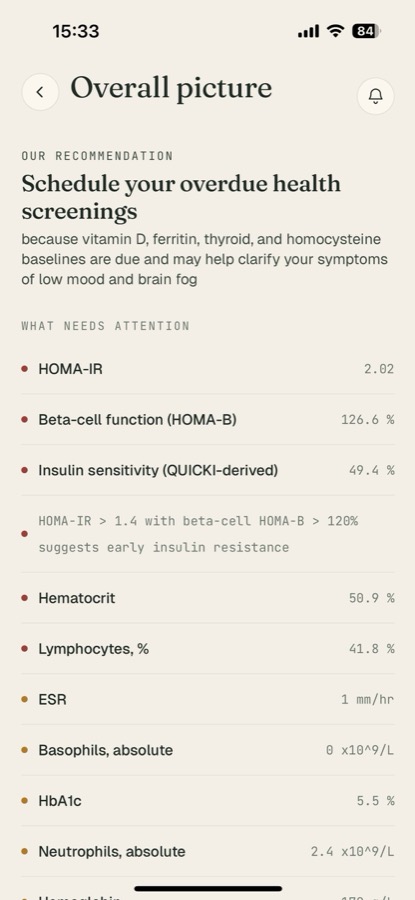
For PCOS, the insulin-resistance picture is the part a standard report leaves you to piece together. On this Bevita “Overall picture” screen, HOMA-IR (2.02) and beta-cell function are calculated and flagged for early insulin resistance — exactly the driver to track in PCOS. Bevita computes HOMA-IR from your fasting insulin and glucose, tracks it alongside your androgen and HbA1c results, and shows whether interventions are moving it — turning scattered results into the metabolic through-line.
What to do
- If you suspect PCOS, ask for the metabolic panel too — fasting insulin/glucose and HbA1c, not just hormones.
- Track the insulin markers — HOMA-IR shows the driver and whether it’s improving.
- Target insulin sensitivity — it often improves symptoms and lowers diabetes risk together.
- Work with a clinician — PCOS diagnosis and management should be individualized (Rotterdam criteria, ruling out mimics).
References
- World Health Organization. Polycystic ovary syndrome.
- Insulin resistance, metabolic syndrome and polycystic ovaries. Frontiers in Endocrinology.
- Freeman AM, Acevedo LA, Pennings N. Insulin Resistance. StatPearls, NCBI.
This article is for education and isn’t medical advice. Discuss your results with a qualified clinician.
Track the PCOS metabolic picture with Bevita
The insulin-resistance side of PCOS is what a stack of lab PDFs makes hardest to see. Upload your labs to Bevita and it calculates HOMA-IR, tracks it alongside your androgen and blood-sugar markers, and flags whether the metabolic driver is improving. Download Bevita, upload your bloodwork, and see the connection behind PCOS.