Apple Health is genuinely good at what it was built for: pulling together steps, heart rate, sleep, and workouts from your iPhone and Apple Watch into one continuous stream. If you want to know how you slept last night or whether your resting heart rate is drifting, it’s right there.
But ask it a different question — “is my ferritin trending down?” or “what does my HOMA-IR say about my blood sugar?” — and it goes quiet. Blood work is a different kind of data, and it needs a different kind of tool.
The stat most people don’t know
The average adult accumulates years of lab results scattered across patient portals, PDFs, and emails — and studies of personal health records consistently find that most people can’t produce their own past bloodwork when asked. The data exists; it’s just fragmented and unreadable. A pile of numbers you can’t see over time isn’t much more useful than no data at all.
What Apple Health does well
- Continuous wearable data — steps, heart rate, HRV, sleep, workouts
- A single timeline for metrics your devices capture automatically
- Health Records — if your provider is connected, it can pull in some clinical data
- Privacy — data stays largely on-device
For the everyday, sensor-driven side of health, it’s hard to beat.
Where it falls short for lab results
- It doesn’t read lab PDFs. Most people get results as a PDF or a portal screenshot. Apple Health can’t ingest those — you’d be typing values by hand.
- It doesn’t calculate derived markers. Scores like HOMA-IR (insulin resistance) or triglyceride-to-HDL ratio require combining values. Apple Health just stores the raw ones.
- It doesn’t flag optimal vs “normal.” A ferritin of 20 shows as a number, not as “functionally low.” (More on that in what low ferritin actually means.)
- It doesn’t connect markers or symptoms. It won’t tell you that your rising HbA1c sits alongside a high HOMA-IR, or that your fatigue lines up with dropping iron.
None of this is a knock on Apple Health — it just wasn’t designed to be a lab interpreter.
What a dedicated lab tracker adds
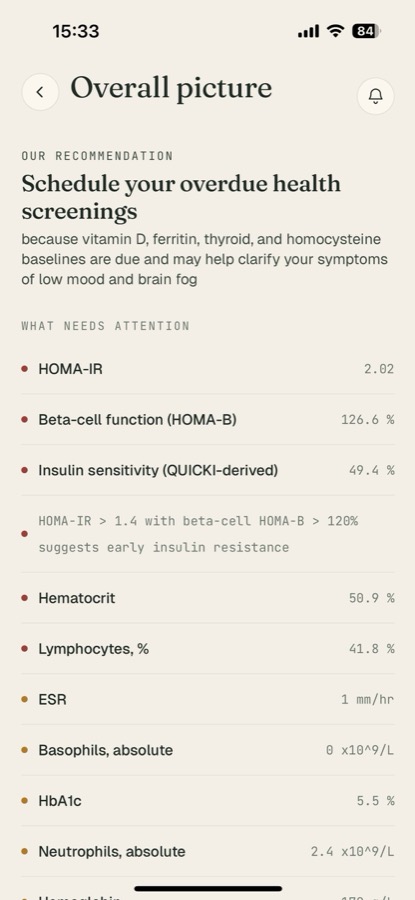
This is Bevita’s “Overall picture” screen — the kind of view a dedicated tracker is built to produce. Notice what’s happening that Apple Health can’t do:
- Derived markers calculated for you — HOMA-IR (2.02), beta-cell function (126.6%), insulin sensitivity (49.4%) — none of which appear on the original lab report.
- Plain-English interpretation — “HOMA-IR > 1.4 with beta-cell HOMA-B > 120% suggests early insulin resistance.”
- Everything read together — iron, inflammation, thyroid, and blood-sugar markers on one screen, with what needs attention surfaced first.
You upload the lab PDF; it does the reading, the math, and the flagging. That’s the gap between storing your numbers and understanding them.
The honest take
Use Apple Health for what it’s great at — the continuous, wearable side of your health. For blood work specifically — uploading results, seeing trends across every test, calculating the markers that matter, and tying labs to how you actually feel — you want a tool built for it. They’re not competitors so much as two halves of the picture.
Related reading on what makes a health app actually useful: why your app should let you export your data, what separates a real health record from an AI chatbot skin, and why ChatGPT can explain your labs but can’t remember them.
This article is for education and isn’t medical advice. Discuss your results with a qualified clinician.
Track your labs with Bevita
If your blood test results are scattered across PDFs and portals, Bevita pulls them into one place, reads them, and shows you what’s changing over time — the part Apple Health leaves out. It calculates the derived markers, flags optimal-vs-normal, and connects results to your symptoms. Download Bevita, upload your lab PDFs, and finally see your bloodwork as a story instead of a stack of files.