Most people have heard of cholesterol as a heart-risk marker. Far fewer have heard of CRP — yet C-reactive protein, measured the right way, is one of the more useful predictors of cardiovascular risk, and it captures something cholesterol doesn’t: inflammation.
What CRP measures
C-reactive protein is made by your liver in response to inflammation anywhere in the body. When you measure it with a sensitive assay — high-sensitivity CRP (hs-CRP) — you can pick up the low-grade, chronic inflammation that quietly contributes to arterial disease, long before symptoms appear.
Standard CRP is used for big inflammatory events like infections. hs-CRP is the version tuned for cardiovascular risk.
The stat most people don’t know
Inflammation is now recognized as a core driver of heart disease — the leading cause of death worldwide (WHO). And hs-CRP adds risk information beyond cholesterol: the 2019 ACC/AHA cholesterol guidelines list an hs-CRP of ≥2.0 mg/L as a “risk enhancer” that can tip an uncertain treatment decision toward action (hs-CRP in Clinical Practice, NCBI). Two people with identical cholesterol can carry very different risk depending on their inflammation.
What the numbers mean
For cardiovascular risk, hs-CRP is grouped into three bands (AHA/CDC, via NCBI):
- Below 1 mg/L — low risk
- 1–3 mg/L — average risk
- Above 3 mg/L — high risk
One important caveat: a reading above 10 mg/L usually means something acute is going on — an infection, injury, or recent vaccine — not your cardiovascular baseline. In that case it should be re-tested once you’re well.
Why the trend matters more than one reading
Because CRP jumps with any temporary inflammation, a single value can mislead in either direction. What’s meaningful is your baseline — the level when you’re healthy and not fighting anything — and whether it’s drifting up over time. That only becomes visible when you track it across several tests, ideally alongside your other cardiovascular markers like cholesterol and the triglyceride-to-HDL ratio.
What this looks like in Bevita
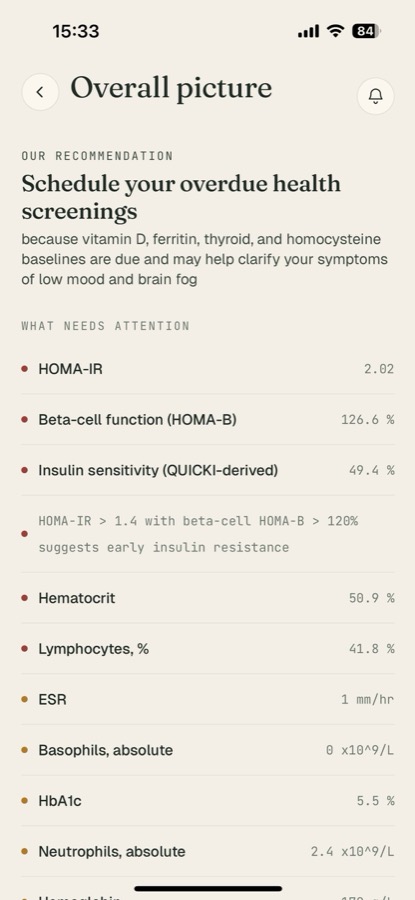
Bevita reads inflammation markers the way it reads everything else on this “Overall picture” screen — not as an isolated value but in context and over time. It flags hs-CRP against the risk bands (not just the lab’s wide “normal”), tracks your baseline across tests so a temporary spike from a cold doesn’t get mistaken for a trend, and shows it beside your lipid and metabolic markers — because inflammation and insulin resistance often travel together.
What to do
- Ask for hs-CRP specifically (not standard CRP) if you’re assessing cardiovascular risk.
- Don’t over-read one value — if it’s high, confirm with a repeat test when you’re well.
- Track your baseline over time, alongside cholesterol and metabolic markers.
- Talk to a clinician — hs-CRP is one input into overall risk, most useful when other risk factors are borderline.
References
- Windgassen EB, et al. The Use of High-Sensitivity C-Reactive Protein in Clinical Practice. NCBI / PMC.
- World Health Organization. Cardiovascular diseases (CVDs).
- American Heart Association. Cholesterol & Cardiovascular Risk.
This article is for education and isn’t medical advice. Discuss your results with a qualified clinician.
Track your inflammation markers with Bevita
CRP is only meaningful as a baseline tracked over time, read alongside your other heart-risk markers. Upload your labs to Bevita and it flags hs-CRP against the risk bands, tracks your baseline across tests, and shows it beside your cholesterol and metabolic markers. Download Bevita, upload your bloodwork, and see the inflammation picture cholesterol alone can’t show.