Most people’s cholesterol conversation stops at LDL. But there’s a marker that captures cardiovascular risk more precisely — one that major guidelines increasingly favor, yet that rarely appears on a standard panel unless you ask. It’s ApoB, and understanding it changes how you read your lipids.
What ApoB actually measures
Here’s the key idea: what clogs arteries isn’t cholesterol floating freely — it’s cholesterol packaged in particles that burrow into artery walls. Every one of those artery-clogging (atherogenic) particles — LDL, VLDL, and others — carries exactly one ApoB protein.
So measuring ApoB counts the total number of risk-carrying particles in your blood. And it turns out the number of particles drives plaque and heart-attack risk more than the total cholesterol they contain.
The stat most people don’t know
The 2019 ESC/EAS guidelines concluded that ApoB is a more accurate marker of cardiovascular risk than either LDL-C or non-HDL cholesterol, and a 2025 review found 9 of 9 studies rated ApoB as more accurate than LDL cholesterol (Journal of the American Heart Association). When ApoB and LDL-C disagree, ApoB is the better predictor of risk.
Why LDL cholesterol can mislead
Two people can have the same LDL cholesterol but a very different number of LDL particles. The one with more, smaller particles carries more ApoB — and more risk — despite an identical LDL-C number. This mismatch is most common exactly where it matters most: in people with high triglycerides, diabetes, or obesity — the insulin-resistant profile. In those cases, LDL cholesterol can quietly underestimate true risk, and ApoB catches it.
What the numbers mean
- Below ~90 mg/dL — general target for average risk
- Below ~80, or even ~65 mg/dL — targets used for higher-risk individuals
- Thresholds depend on your overall risk profile, so interpret with a clinician
The catch: ApoB isn’t on most standard lipid panels. You typically have to request it by name.
What this looks like in Bevita
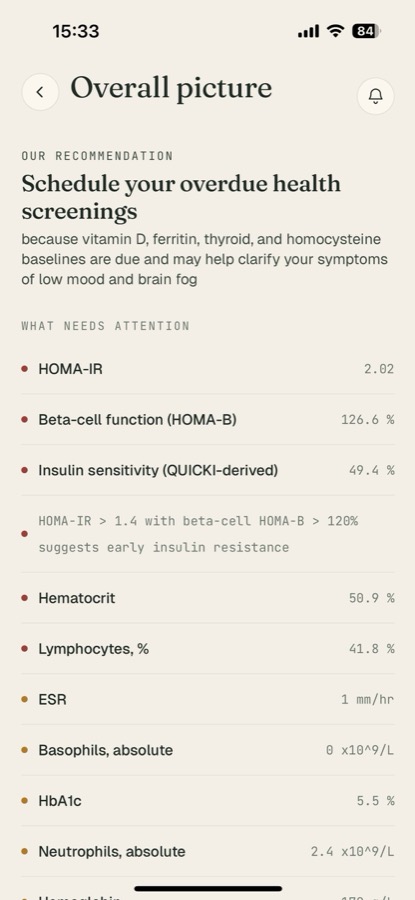
If you do get an ApoB, it’s most useful read alongside your LDL, HDL, triglycerides, and metabolic markers — not as a lone number. Bevita tracks ApoB together with the rest of your lipid panel, flags it against target ranges, and shows the trend over time, so you can see the fuller, particle-level risk picture rather than the cholesterol-content-only view a basic panel gives.
What to do
- Ask for ApoB by name — it’s usually not included by default.
- Prioritize it if you have high triglycerides, diabetes, or extra weight — that’s where LDL-C most underestimates risk.
- Read it with your full panel, not in isolation.
- Talk to a clinician to set a target appropriate to your overall risk.
References
- Sniderman AD, et al. Physiological Bases for the Superiority of ApoB as a Marker of Cardiovascular Risk. Journal of the American Heart Association.
- American Heart Association. HDL, LDL Cholesterol and Triglycerides.
- National Heart, Lung, and Blood Institute (NHLBI). Blood Cholesterol.
This article is for education and isn’t medical advice. Discuss your results with a qualified clinician.
Track your ApoB with Bevita
ApoB is most powerful read alongside your full lipid and metabolic picture, over time. Upload your labs to Bevita and it tracks ApoB with your LDL, HDL, triglycerides, and insulin markers, flags it against targets, and shows the trend. Download Bevita, upload your panel, and see risk at the particle level.