TSH 8.8: What This Level Means
A TSH of 8.8 sits close to the level where treatment is usually advised. What that means, why free T4 decides it, and what to test alongside.
Approaching the treatment thresholdWhere 8.8 sits
At 8.8 mIU/L you are 4.8 above the 4 ceiling of the reference range — about 2.2× the upper limit — and 1.2 below 10, the level at which treatment for an underactive thyroid is usually recommended.So this sits in the gap where the decision is a judgement rather than a rule. A further rise of 1.2 would cross into the range where levothyroxine is normally started; a fall of 4.8 would bring you back inside normal.
| Your value | 8.8 mIU/L |
|---|---|
| Usual reference range | 0.4 – 4 mIU/L (varies by lab) |
| Where it falls | Approaching the treatment threshold |
| Treatment threshold | Usually around 10 mIU/L for an underactive thyroid |
What a TSH of 8.8 means
This is the upper reach of subclinical hypothyroidism — above the range by a clear margin and close to the point where most guidance stops recommending observation and starts recommending treatment.
At this level the odds shift. Antibodies are more often positive, symptoms are more often present, and progression to overt hypothyroidism over the following years is more likely than it is at a marginal result. The pituitary is pushing hard to keep hormone output normal, and that compensation tends not to hold indefinitely.
Free T4 becomes the deciding test. Still normal, and this remains subclinical; already falling, and the picture is overt hypothyroidism regardless of which side of 10 the TSH sits.
What causes a TSH at this level
- Hashimoto's thyroiditis, usually with positive TPO antibodies
- Inadequate levothyroxine dose, or taking it with food, calcium or iron
- Post-surgical or post-radioiodine hypothyroidism under-replaced
- Medications including amiodarone, lithium and some immunotherapies
Does a TSH of 8.8 need treatment?
Treatment is commonly started in this band, particularly under 65, with symptoms, with positive antibodies, or with cardiovascular risk. Where it is not started, the follow-up interval is usually short — months, not years — because progression is likely enough to warrant watching closely.
What to test alongside it
- Free T4 — the test that separates subclinical from overt
- TPO antibodies to confirm the cause and gauge progression risk
- Lipid panel, often raised and often improving with treatment
- Ferritin and B12, commonly low alongside autoimmune thyroid disease
How soon to act
Worth an appointment in the near term rather than at your next routine visit — sooner with significant symptoms, pregnancy, or existing heart disease.
Why one reading is never the whole story
TSH moves. It peaks overnight and early in the morning, shifts with illness and with the laboratory doing the measuring, and responds slowly to any real change — which is why a single value of 8.8 is a starting point rather than a conclusion. The same number means one thing if it has been stable for years and something quite different if it has been climbing across your last three tests.
What this looks like in Bevita
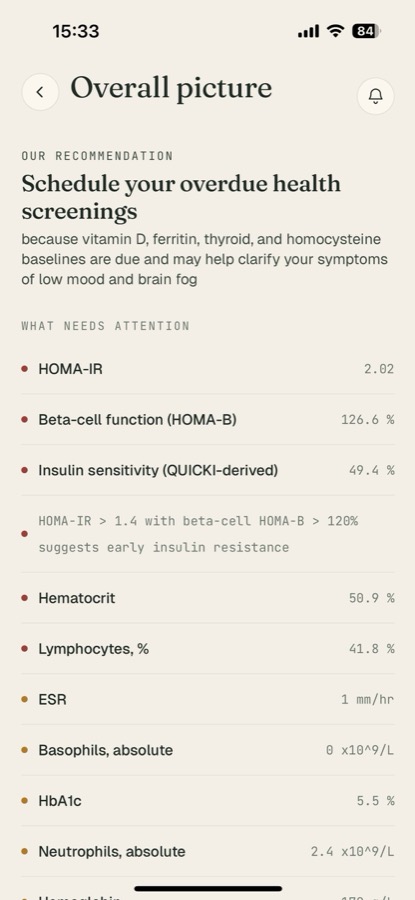
This is the part a single result cannot give you. Bevita keeps every lab report you upload with its date, so your TSH becomes a line rather than a number — and reads it next to free T4 and the symptoms you log instead of in isolation.
Upload the report this value came from and you will see where 8.8 sits against your own history, not just against a reference range built from strangers.
Related reading
- high TSH: what your thyroid is telling you
- what an underactive thyroid feels like
- testing for Hashimoto's with TPO antibodies
- why an underactive thyroid raises cholesterol
Nearby TSH values
- TSH 3.9 Top of the normal range
- TSH 4.8 Just above the reference range
- TSH 5.5 Mild subclinical hypothyroidism
- TSH 11 Overt hypothyroidism range
- TSH 30 Marked hypothyroidism
- TSH 100 Severe hypothyroidism
References
- National Institute of Diabetes and Digestive and Kidney Diseases. Hypothyroidism.
- Subclinical Hypothyroidism. StatPearls, NCBI.
- American Thyroid Association. Hypothyroidism.
This page is for education and isn't medical advice. Reference ranges vary between laboratories — check the range printed on your own report, and discuss your results with a qualified clinician.
Frequently asked questions
- Is a TSH of 8.8 normal?
- No — 8.8 mIU/L falls outside the usual reference range of about 0.4 to 4 mIU/L. It sits in what is generally described as the approaching the treatment threshold. Reference ranges do vary between laboratories, so compare against the range printed on your own report.
- Does a TSH of 8.8 need treatment?
- Treatment is commonly started in this band, particularly under 65, with symptoms, with positive antibodies, or with cardiovascular risk. Where it is not started, the follow-up interval is usually short — months, not years — because progression is likely enough to warrant watching closely.
- What should I test alongside a TSH of 8.8?
- Free T4, TPO antibodies to confirm the cause and gauge progression risk, Lipid panel, often raised and often improving with treatment, Ferritin and B12, commonly low alongside autoimmune thyroid disease. TSH on its own cannot separate the pituitary's signal from the thyroid's actual output, which is why free T4 is the usual companion test.
See what your TSH has actually been doing
Upload your lab reports to Bevita and it tracks your TSH and free T4 across every test, reads them together, and ties them to how you've been feeling. Free to start.
Download on the App Store