TSH 1.5: What This Level Means
A TSH of 1.5 is squarely normal, so if you feel unwell the answer is likely elsewhere on the panel. What this level means and what to check next.
Mid-normalWhere 1.5 sits
At 1.5 mIU/L you are inside the usual 0.4–4 range: 1.1 above the floor and 2.5 below the ceiling, which puts you about 31% of the way up the reference band.A rise of 2.5 would take you out of range at the top; a fall of 1.1 would take you out at the bottom. Neither is a large movement for a marker that varies through the day, which is why one reading is a starting point rather than a verdict.
| Your value | 1.5 mIU/L |
|---|---|
| Usual reference range | 0.4 – 4 mIU/L (varies by lab) |
| Where it falls | Mid-normal |
| Treatment threshold | Usually around 10 mIU/L for an underactive thyroid |
What a TSH of 1.5 means
This is about as unremarkable as a TSH gets, and it is where most healthy adults land. The feedback loop between pituitary and thyroid is balanced: the signal being sent matches the hormone being made.
It is also the range replacement therapy usually targets, so if you take levothyroxine, a result here generally means the dose is right.
Which makes the useful question a different one. If you had this test because of fatigue, weight change or brain fog, a mid-normal TSH is fairly strong evidence the thyroid is not the culprit — and the most common actual culprits are low iron stores, low vitamin D, low B12 and blood-sugar problems, all of which are cheap to check and routinely missed.
What this result tells you
- Thyroid regulation is working normally
- Replacement therapy is well dosed, if you take it
- Symptoms need another explanation — iron, vitamin D, B12 or metabolic markers
- Autoimmunity is still possible — TPO antibodies can be positive years before TSH shifts
Does a TSH of 1.5 need treatment?
No thyroid treatment is indicated. If symptoms persist, the productive step is widening the panel rather than re-testing this number repeatedly.
What to test alongside it
- Ferritin — low iron stores mimic thyroid symptoms and are far more common
- Vitamin D and B12 — both produce fatigue and brain fog
- HbA1c and fasting insulin — for the metabolic side of low energy
- TPO antibodies if thyroid disease runs in your family
How soon to act
None. The point of a result like this is to stop looking at the thyroid and start looking elsewhere.
Why one reading is never the whole story
TSH moves. It peaks overnight and early in the morning, shifts with illness and with the laboratory doing the measuring, and responds slowly to any real change — which is why a single value of 1.5 is a starting point rather than a conclusion. The same number means one thing if it has been stable for years and something quite different if it has been climbing across your last three tests.
What this looks like in Bevita
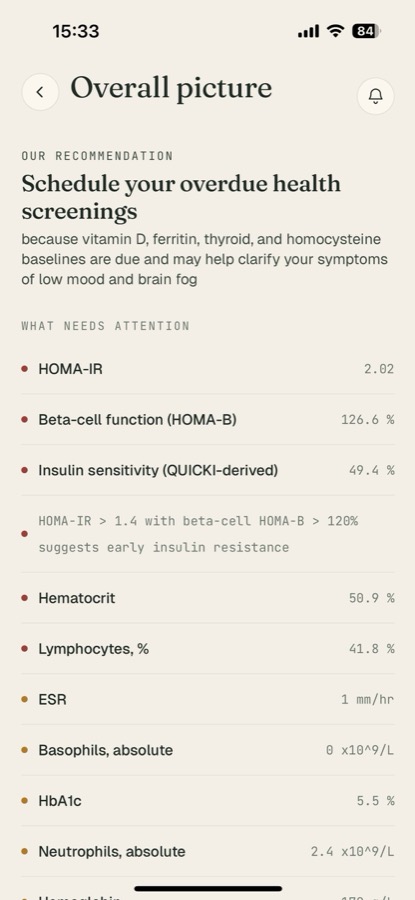
This is the part a single result cannot give you. Bevita keeps every lab report you upload with its date, so your TSH becomes a line rather than a number — and reads it next to free T4 and the symptoms you log instead of in isolation.
Upload the report this value came from and you will see where 1.5 sits against your own history, not just against a reference range built from strangers.
Related reading
- the six markers behind most persistent fatigue
- what low ferritin actually means
- testing for Hashimoto's with TPO antibodies
Nearby TSH values
- TSH 0.1 Clearly below range
- TSH 0.3 Just below range
- TSH 0.5 Low end of normal
- TSH 2.5 Upper-middle of normal
- TSH 3.5 High-normal
- TSH 3.9 Top of the normal range
References
- National Institute of Diabetes and Digestive and Kidney Diseases. Hypothyroidism.
- Pierce E, et al. Physiology, Thyroid Stimulating Hormone. StatPearls, NCBI.
This page is for education and isn't medical advice. Reference ranges vary between laboratories — check the range printed on your own report, and discuss your results with a qualified clinician.
Frequently asked questions
- Is a TSH of 1.5 normal?
- Yes — 1.5 mIU/L falls inside the usual reference range of about 0.4 to 4 mIU/L, so it is reported as normal. Ranges vary slightly between laboratories, and this value sits in the mid-normal part of that range.
- Does a TSH of 1.5 need treatment?
- No thyroid treatment is indicated. If symptoms persist, the productive step is widening the panel rather than re-testing this number repeatedly.
- What should I test alongside a TSH of 1.5?
- Ferritin, Vitamin D and B12, HbA1c and fasting insulin, TPO antibodies if thyroid disease runs in your family. TSH on its own cannot separate the pituitary's signal from the thyroid's actual output, which is why free T4 is the usual companion test.
See what your TSH has actually been doing
Upload your lab reports to Bevita and it tracks your TSH and free T4 across every test, reads them together, and ties them to how you've been feeling. Free to start.
Download on the App Store