TSH 0.3: What This Level Means
A TSH of 0.3 is a shade under the reference range, close enough that another lab might call it normal. What it means and why repeating matters.
Just below rangeWhere 0.3 sits
At 0.3 mIU/L you are 0.1 below the 0.4 floor of the usual reference range — roughly 1.33× lower than the bottom of normal.To come back inside the range this would need to rise by at least 0.1. Because TSH is reported on a scale where small absolute differences carry weight at the low end, that gap is larger than it looks.
| Your value | 0.3 mIU/L |
|---|---|
| Usual reference range | 0.4 – 4 mIU/L (varies by lab) |
| Where it falls | Just below range |
| Treatment threshold | Usually around 10 mIU/L for an underactive thyroid |
What a TSH of 0.3 means
This is the mildest possible abnormal result on the low side — close enough to the boundary that some laboratories, using a slightly different reference interval, would report it as normal.
Because TSH varies through the day and between labs, a value this close to the cut-off is frequently just noise. It is one of the few results where "repeat it and see" is genuinely the best medicine rather than a delay tactic.
Why TSH lands just under the line
- Normal day-to-day variation — TSH is lowest in the afternoon and evening
- A different reference interval at the testing laboratory
- Very early or mild thyroid overactivity
- Thyroid medication set slightly high
- Recent illness or corticosteroids, both of which transiently lower TSH
Does a TSH of 0.3 need treatment?
No treatment for a result this marginal. A repeat in a few months, ideally drawn at a similar time of day and at the same laboratory, resolves most cases without anything further.
What to test alongside it
- Free T4 — the test that decides whether this means anything at all
- A repeat TSH, same lab, same time of day
How soon to act
Not urgent. Worth mentioning at your next appointment rather than making a separate one, unless you have symptoms of an overactive thyroid.
Why one reading is never the whole story
TSH moves. It peaks overnight and early in the morning, shifts with illness and with the laboratory doing the measuring, and responds slowly to any real change — which is why a single value of 0.3 is a starting point rather than a conclusion. The same number means one thing if it has been stable for years and something quite different if it has been climbing across your last three tests.
What this looks like in Bevita
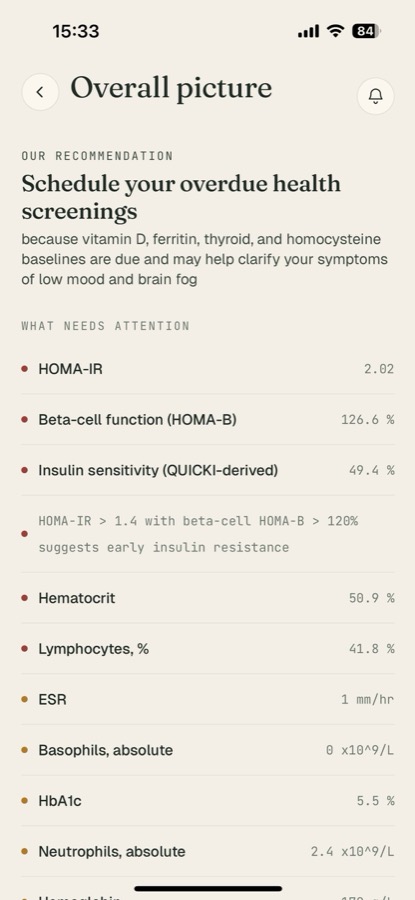
This is the part a single result cannot give you. Bevita keeps every lab report you upload with its date, so your TSH becomes a line rather than a number — and reads it next to free T4 and the symptoms you log instead of in isolation.
Upload the report this value came from and you will see where 0.3 sits against your own history, not just against a reference range built from strangers.
Related reading
- why hyperthyroidism shows a low TSH, not a high one
- free T3 and free T4 explained
- what an ultrasensitive TSH assay actually measures
Nearby TSH values
- TSH 0.01 Effectively undetectable
- TSH 0.05 Deeply suppressed
- TSH 0.1 Clearly below range
- TSH 0.5 Low end of normal
- TSH 1.5 Mid-normal
- TSH 2.5 Upper-middle of normal
References
- Pierce E, et al. Physiology, Thyroid Stimulating Hormone. StatPearls, NCBI.
- American Thyroid Association. Hyperthyroidism.
This page is for education and isn't medical advice. Reference ranges vary between laboratories — check the range printed on your own report, and discuss your results with a qualified clinician.
Frequently asked questions
- Is a TSH of 0.3 normal?
- No — 0.3 mIU/L falls outside the usual reference range of about 0.4 to 4 mIU/L. It sits in what is generally described as the just below range. Reference ranges do vary between laboratories, so compare against the range printed on your own report.
- Does a TSH of 0.3 need treatment?
- No treatment for a result this marginal. A repeat in a few months, ideally drawn at a similar time of day and at the same laboratory, resolves most cases without anything further.
- What should I test alongside a TSH of 0.3?
- Free T4, A repeat TSH, same lab, same time of day. TSH on its own cannot separate the pituitary's signal from the thyroid's actual output, which is why free T4 is the usual companion test.
See what your TSH has actually been doing
Upload your lab reports to Bevita and it tracks your TSH and free T4 across every test, reads them together, and ties them to how you've been feeling. Free to start.
Download on the App Store