Your kidneys quietly filter about 150 quarts of blood a day, and they rarely complain until a lot of function is already lost. That’s what makes kidney disease so easy to miss — and why the numbers around it are so striking. The good news: two simple tests catch it early, long before you’d feel anything.
The stat most people don’t know
About 1 in 7 US adults — roughly 35–37 million people — has chronic kidney disease (CKD), and an estimated 90% of them don’t know it (CDC; National Kidney Foundation). Even among people with severely reduced function, a large share are unaware. It’s one of the most under-recognized common conditions there is — precisely because early CKD has no symptoms.
The two markers that catch it
eGFR (from creatinine)
Creatinine is a waste product your kidneys clear. From your blood creatinine (plus age and sex), labs calculate eGFR — estimated glomerular filtration rate, the headline measure of filtering capacity:
- 90+ — normal
- 60–89 — normal if no other signs of damage
- Below 60 for 3+ months — suggests CKD
Urine albumin (uACR)
The blood test alone isn’t enough. A urine albumin-to-creatinine ratio detects small amounts of protein leaking into the urine — often the earliest sign of kidney damage, appearing while eGFR still looks normal. Ask for both.
Why the trend matters
eGFR naturally drifts down with age, so a single value can mislead. What matters is the rate of change: an eGFR that’s dropped from 95 to 78 over two years is a different story than one stable at 78 for a decade. This is why tracking over time — not a one-off reading — is how kidney decline is actually caught.
The metabolic connection
The two biggest drivers of CKD are high blood pressure and diabetes — which means kidney health is tightly linked to the same metabolic picture behind insulin resistance and metabolic syndrome. Controlling blood sugar and blood pressure is also the main way to protect the kidneys, so these markers are best read together.
What this looks like in Bevita
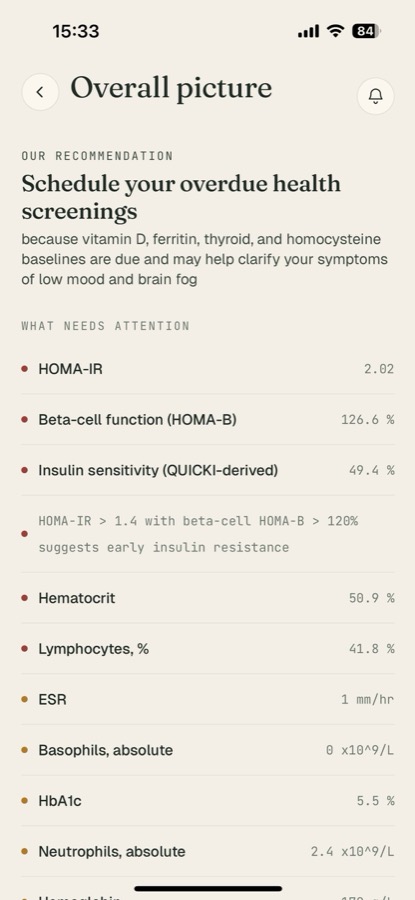
Kidney decline is a slow trend, and slow trends are exactly what get lost in a stack of once-a-year lab PDFs. Bevita tracks eGFR and creatinine across every test, flags the direction rather than just the single value, and reads them alongside the blood-sugar and blood-pressure-linked markers that drive kidney risk — so a gradual eGFR slide becomes visible early, while there’s still time to act.
What to do
- Ask for both eGFR and urine albumin (uACR) — the blood test alone can miss early damage.
- Track eGFR over time — the rate of decline matters more than one reading.
- Control the drivers — blood pressure and blood sugar are the biggest levers.
- Talk to a clinician, especially if you have diabetes, high blood pressure, or a family history of kidney disease.
References
- Centers for Disease Control and Prevention. Chronic Kidney Disease in the United States.
- National Kidney Foundation. 37 Million American Adults Now Estimated to Have Chronic Kidney Disease.
- National Institute of Diabetes and Digestive and Kidney Diseases (NIDDK). Estimated Glomerular Filtration Rate (eGFR).
This article is for education and isn’t medical advice. Discuss your results with a qualified clinician.
Track your kidney markers with Bevita
Kidney decline is silent and slow — which means the trend is everything. Upload your labs to Bevita and it tracks eGFR and creatinine over time, flags the direction, and reads them alongside the metabolic markers that drive kidney risk. Download Bevita, upload your bloodwork, and catch the silent one early.