Your lab report shows a ferritin of 25. The reference range says 12-300 is “normal.” Your doctor says it’s fine.
But you’re tired all the time. Your hair is thinning. You can’t focus.
Here’s the problem: the “normal” range on your lab report isn’t the same as the optimal range.
Ferritin levels chart
| Ferritin Level | Status | What It Means |
|---|---|---|
| Below 12 | Deficient | Your iron stores are depleted. Supplementation usually needed. |
| 12-30 | Borderline low | Functionally low for many people. Symptoms common. Worth discussing with doctor. |
| 30-100 | Optimal | Good range for most adults. Enough iron for daily needs. |
| 100-200 | Normal-high | Still fine, but monitor if trending upward. |
| 200-300 | High | May indicate inflammation, liver issues, or iron overload. |
| Above 300 | Elevated | Needs investigation. Could be hemochromatosis or chronic inflammation. |
Why “normal” isn’t enough
The lab reference range (12-300) is based on the statistical distribution of the population. It includes everyone from healthy athletes to people with chronic illness. Being “in range” just means you’re not in the bottom 2.5% or top 2.5% of the population.
But functional iron deficiency — where your body doesn’t have enough iron to function optimally — can occur even when ferritin is technically “normal.” A cutoff of 30 ng/mL is about 92% sensitive and 98% specific for iron deficiency (AAFP) — far more useful than the lab’s floor of 12–15, which the WHO uses only to define outright depletion (WHO guideline, NCBI).
Symptoms of low ferritin
- Fatigue and low energy
- Brain fog and difficulty concentrating
- Hair thinning or loss
- Cold hands and feet
- Restless legs, especially at night
- Shortness of breath during exercise
- Brittle nails
- Pale skin
Who’s at risk
- Women with heavy periods — monthly blood loss depletes iron stores
- Vegetarians and vegans — plant-based iron is less bioavailable
- Endurance athletes — iron loss through sweat and foot-strike hemolysis
- People with digestive issues — celiac, Crohn’s, or gut inflammation
- Frequent blood donors — each donation removes ~200-250mg of iron
What this looks like in Bevita
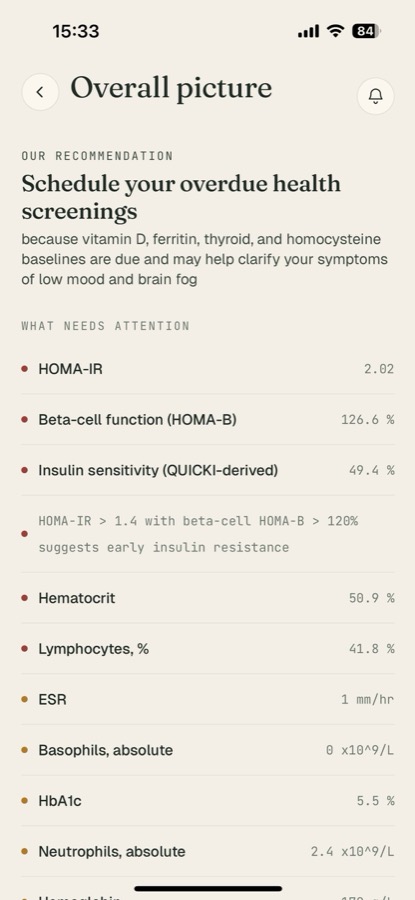
A chart tells you where 25 ng/mL sits. It can’t tell you whether you were at 60 two years ago. On this Bevita “Overall picture” screen, ferritin appears with the other markers and a recommendation attached, rather than as an isolated figure in a PDF.
Upload each report as it arrives and Bevita keeps your ferritin history with dates, so a slide from 70 to 40 to 25 reads as a trajectory — the thing that actually warrants action — instead of three separate “normal” results filed in three separate places.
What to do
- Get a full iron panel — not just ferritin, but also serum iron, TIBC, and transferrin saturation
- Track over time — a single number is a snapshot; trends tell the story
- Talk to your doctor — if ferritin is below 30 and you have symptoms
- Don’t self-supplement — too much iron is dangerous. Get tested first.
References
- Short MW, Domagalski JE. Iron Deficiency Anemia: Evaluation and Management. American Family Physician (AAFP).
- World Health Organization. WHO guideline on use of ferritin concentrations to assess iron status (NCBI).
- National Institutes of Health, Office of Dietary Supplements. Iron — Health Professional Fact Sheet.
This article is for education and isn’t medical advice. Discuss your results with a qualified clinician.
Track your ferritin with Bevita
Bevita tracks your ferritin over time, shows you the trend, and flags when it’s time to retest. If your ferritin has been dropping, it connects that pattern to your symptoms.
Free tier. Upload your first lab result in 30 seconds.